4 October 2026 · YouTube Ban Service · ~15 min read
How to trademark a YouTube channel name, and what a registration does on YouTube
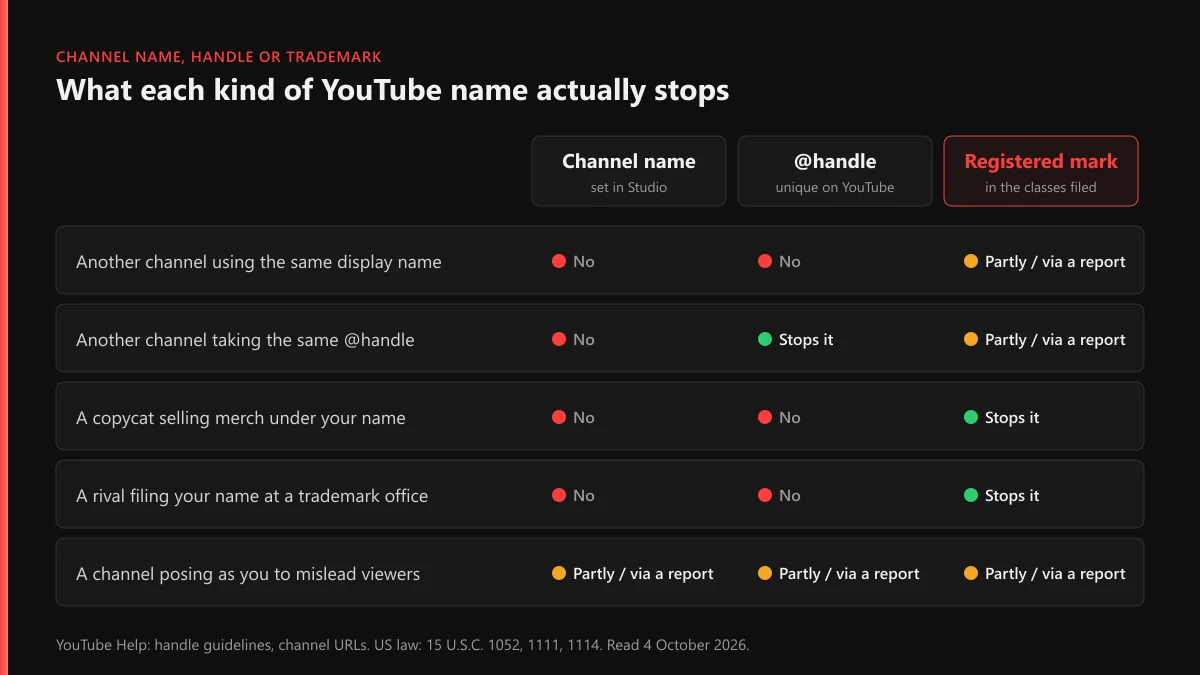
You trademark a YouTube channel name by registering it as a mark for the service you offer under it, usually online videos in Class 41, at an office such as the USPTO ($350 per class). A handle only reserves the name on YouTube. A registration lets you act against copies elsewhere too, but only in the classes you file.
Can you trademark a YouTube channel name at all?
Yes, as long as the name works as a brand. A trademark office doesn't care that the word is a channel. It asks whether the word tells people who is behind a service, and a channel name that viewers recognise does exactly that for online video. So if you're asking "can I trademark my YouTube name", the office's question back is narrower: is the name distinctive, is it free of earlier marks, and is it really yours to file?
In the United States those three questions map onto Section 2 of the Lanham Act. A name that merely describes the videos, like "Easy Home Workouts", gets refused as descriptive under 2(e)(1). One that's likely to be confused with an earlier mark for related services is refused under 2(d). And a name "identifying a particular living individual" can only be registered with that person's written consent, which is rule 2(c). Stage names count. Every MKBHD record we looked at carries the line that the name "identifies the stage name of Marques Brownlee, a living individual whose consent is of record."
So can you trademark a YouTube name that is just your own first and last name? You can, with your consent on file, but expect more pushback if the surname is common. A coined word does best. The same goes if you want to trademark YouTube username strings left over from the old /user/ addresses: the office registers the word you trade under, not the address it sits at.
What did the US register show for 14 well-known channel names?
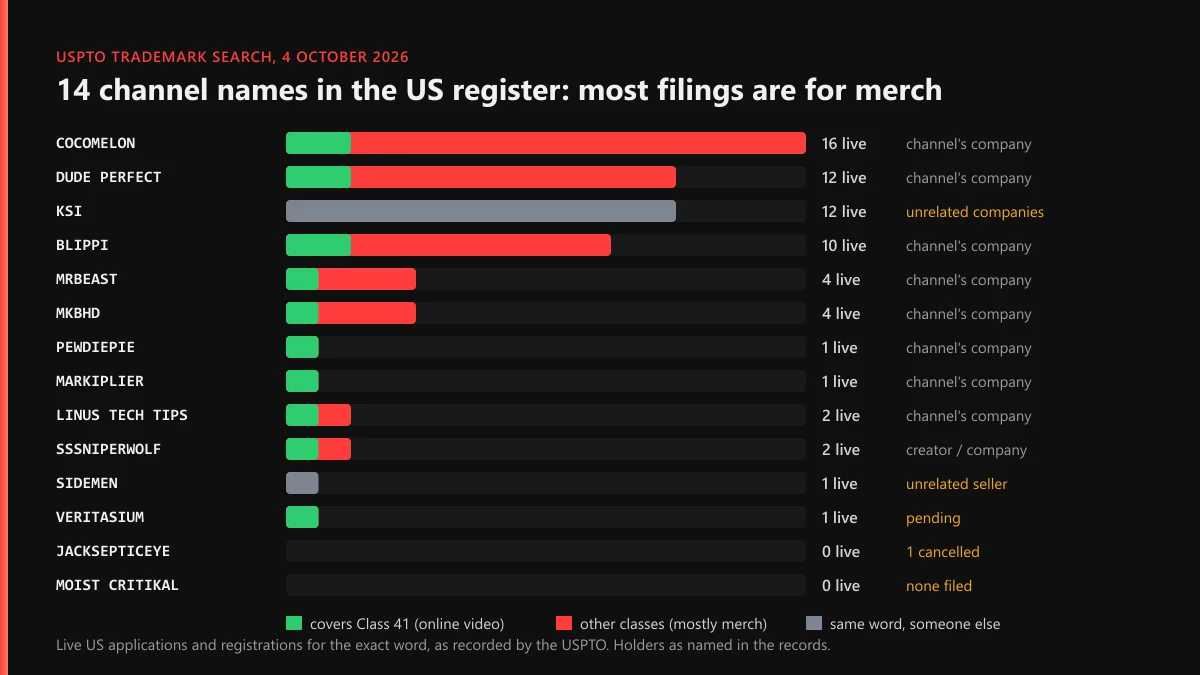
We wanted to see how established creators actually handled this, so on 4 October 2026 we queried the USPTO trademark search for the exact word of 14 channel names. We counted live applications and registrations, then checked who held them and which classes they covered. The ownership column comes from the records, not from guesswork.
| Channel name | Live US filings for the exact word | Who holds them, per the records | What stands out |
|---|---|---|---|
| CoComelon | 16, all registered | The channel's production companies | 24 classes, 2 of the filings cover Class 41 video services |
| Dude Perfect | 12, 8 registered | Dude Perfect, LLC | Snacks, drinks, toys, bags; 2 filings in Class 41 |
| Blippi | 10, all registered | Blippi LLC and Moonbug | Consent statements of the performer on file |
| MrBeast | 4, 2 registered | Beast Holdings and Mrbeastyoutube, LLC | A January 2026 filing for jerky and meat snacks |
| MKBHD | 4, all registered | JMMS, LLC | All four filed the same day, 16 September 2015 |
| Linus Tech Tips | 2, both registered | Linus Media Group | Class 41 for online videos, Class 25 for clothing |
| SSSniperWolf | 2, 1 registered | Alia Shelesh and Impressed Inc | The Class 41 application was in opposition |
| PewDiePie | 1, registered and renewed | Pewdie Productions AB | Filed September 2012, before most channels thought about it |
| Markiplier | 1, registered | Markiplier Inc. | Three earlier filings by an unrelated individual, all abandoned |
| Veritasium | 1, pending | A Delaware LLC | Filed November 2025, answering an office action |
| KSI | 12 | Unrelated firms such as KSi Conveyor | Conveyors and software. Short names collide |
| Sidemen | 1 | An unrelated individual applicant | Registered in 2024 for cables and chargers |
| Jacksepticeye | 0 | An Irish company held one until it lapsed | Registered 2019, later cancelled under Section 71 |
| Moist Critikal | 0 | Nobody | No filing for the exact word |
Across those 14 words the register held 66 live filings, and only 14 of them include Class 41, the class for providing videos. The rest mostly protect things the name is printed on: hoodies, toys, phone cases, snacks.
Two records worth reading closely
Markiplier is the cautionary one. In June and July 2017 an individual with no link to the channel shown in the records filed MARKIPLIER three times, for video game entertainment and for t-shirts. All three were abandoned when the applicant didn't respond to the office. Markiplier Inc. filed its own application in April 2019, with Mark Fischbach's consent recorded, and it registered on 21 July 2020. Sidemen is the reverse lesson. The only live US record for that exact word is a 2024 registration for electric cables and chargers, held by someone outside the group. Two owners of one word, in unrelated classes, can both be legitimate.
Do you need to trademark your YouTube channel name?
Not to run the channel. YouTube asks for no trademark to pick a channel name or claim a handle, and nothing on a channel changes the day a registration issues. So the honest reply to "do I need to trademark my YouTube channel name", or the shorter "do I need to trademark my YouTube name", is no, not to exist on YouTube. "Should I trademark my YouTube channel name?" is a different question. It turns on whether anything you earn depends on the name off YouTube.
Signs it's worth filing:
- You sell, or are about to sell, merch, a product line or a paid course under the name.
- Brand deals and licensing contracts ask you to warrant that you own the name.
- Copycat channels, shops or apps already use the name or something close to it.
- You plan to grow into other platforms, other countries or a company that could be sold.
Reasons to wait: the name is still changing, it describes the content rather than naming it, or the channel isn't earning yet. In the US you get some rights from use alone, without filing, but they're limited to the area where you're known and they're harder to prove. You can put ™ after the name today. The ® symbol is reserved for federally registered marks under 15 U.S.C. 1111, and using it before registration is a misrepresentation. So should you trademark your YouTube name? File once the name earns money or attracts copies. Before that, a ™ and a dated record of your first upload under the name usually do enough.
How do you trademark a YouTube channel name in the US, step by step?
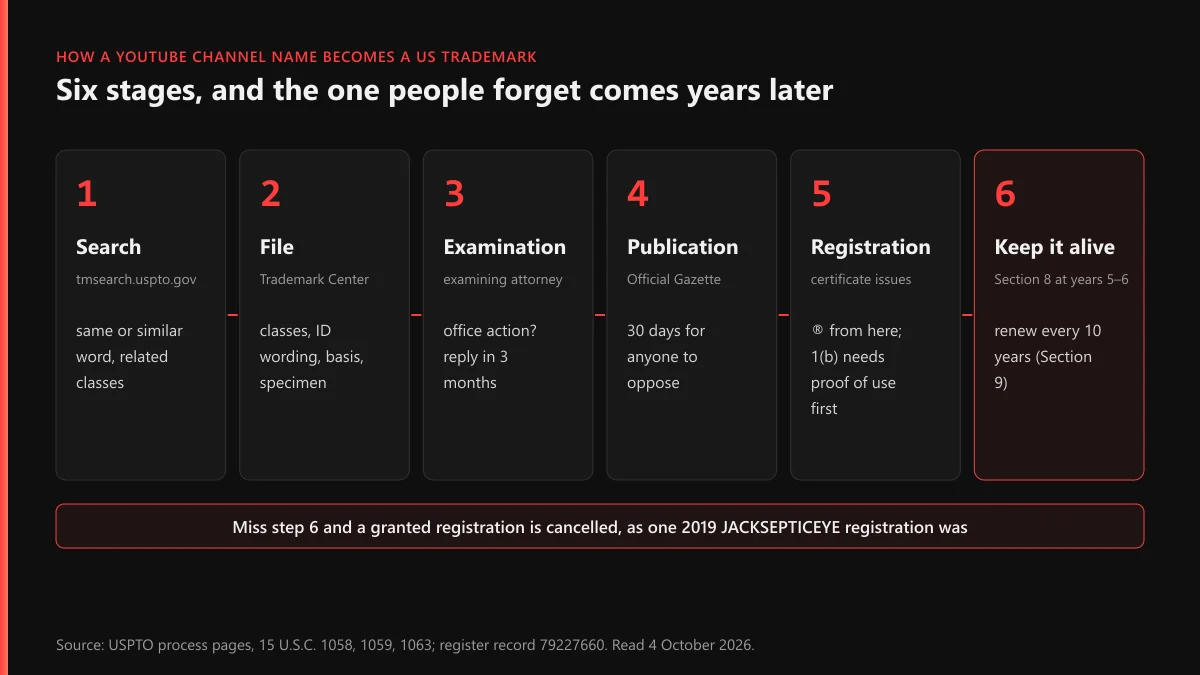
Six steps, roughly ten months end to end, and $350 per class in office fees. That's how to trademark a YouTube channel name at the USPTO. A UK or EU filing follows the same logic with different forms. If you only want the short version of how to trademark a YouTube name, it's this: search, describe the services, show use, file, answer the examiner, maintain. Here are the steps in full, for a channel that has published under its name for a while:
- Search first. Run the exact name and close spellings through the USPTO trademark search, and check the classes that matter to a channel: 41 for video and entertainment, 9 for downloadable videos and apps, 25 for clothing, 35 for advertising and sponsorship services.
- Write the services properly. The examination manual accepts Class 41 wording such as "Providing non-downloadable videos in the field of {subject} via a website". It rejects vague entries like "providing a website featuring entertainment". Linus Media Group's registration is a good model: "Providing online non-downloadable videos in the fields of consumer electronics, technology, computers and computer games."
- Pick the filing basis. Use the name now: file under Section 1(a) with a specimen. Not using it yet for, say, merch: file under 1(b), intent to use, and prove use later.
- Capture the specimen. A screenshot of the channel page showing the name next to the videos works for Class 41. A web page specimen must include its URL and the access or print date, and a mockup or edited image is refused.
- File in Trademark Center and answer the office. If you live outside the US, you must use a US-licensed attorney, a rule in force since 3 August 2019. Office actions get a reply within the deadline, then the mark is published for 30 days so anyone can oppose it.
- Register, then diarise year five. After registration, a Section 8 declaration is due between the fifth and sixth year, and renewal every ten.
The last step is the one creators drop. One registration for JACKSEPTICEYE, granted in January 2019 through the international Madrid route, now shows as cancelled under Section 71, which is that route's version of the year-six declaration.
What does it cost, and how long does it take?
Fees are charged per class, so every class you add to the filing costs you again. These are the current official figures:
| Office | First class | Each extra class | Notes |
|---|---|---|---|
| USPTO (US) | $350 | $350 | +$100 if information is missing, +$200 for free-text services, +$200 per extra 1,000 characters |
| USPTO, later stages | $150 per class | $150 | Statement of use for 1(b) filings; each extension $125 |
| USPTO, upkeep | $325 per class | $325 | Section 8 declaration; renewal another $325 per class |
| UK IPO | £205 | £60 | Online filing, fees from 1 April 2026 |
| EUIPO (all EU states) | €850 | €50 for the 2nd, €150 from the 3rd | Online filing |
US figures are from the USPTO fee schedule, UK figures from the IPO's forms and fees page, and EU figures from EUIPO's fee page. A two-class US filing for videos and clothing therefore starts at $700 in office fees, before any attorney. On timing, the USPTO reported in May 2026 that first actions in the first half of fiscal 2026 took 4.45 months, and that applications took 10.03 months in total.
How to trademark YouTube channel name rights outside the US
File where your audience and your sales are, not where YouTube is based. A UK channel selling merch at home needs the UK IPO. A creator with buyers across Europe can cover every EU member state with one EUIPO filing, for less than separate national ones. If you already hold a home registration, the Madrid system lets you extend it to other countries from one application. That's how the JACKSEPTICEYE registration above reached the US register, and why its upkeep ran on Madrid's Section 71 clock. The searches, classes and specimen logic carry over, but each office examines on its own: a name that clears in London can still be refused in Alicante.
Which version of the name should go on the application?
The word your audience uses to find you, written as you use it. The @ in a handle isn't part of the mark: YouTube adds it, and an office would read "@ name" as the word plus a symbol. File the bare word in standard characters, which covers it in any font, and file a logo separately later if the logo matters. If your channel name and handle differ, file the one that appears on your merch and in sponsorship contracts.
A real name is the trickier case. MrBeast's company filed MRBEAST again in January 2026, this time for jerky and meat snacks. The record says the name "identifies James Donaldson, a living individual whose consent is made of record", and by the time we checked, the office had issued a notice of allowance. If you file through your own company, that consent letter is yours to sign. If a manager or a network files for you, check that the application names your business as owner. The register shows who owns the name, not who appears in the videos.
A trademark YouTube name search should also cover spellings that sound alike. A 2(d) refusal compares how marks sound and look, and the same goes for YouTube's own impersonation policy.
What can a registered trademark do for you on YouTube itself?
It gives you a form that nobody else can use against that channel. YouTube's trademark policy prohibits videos and channels that infringe trademarks, and the trademark complaint form opens without a sign-in. It asks for the owner's full legal name, your authority to complain, the mark type, the jurisdiction and registration number, proof of ownership, the video or channel URLs, and a description of how the mark is misused. One option reads "No, I claim use rights", so an unregistered mark can be submitted too. In practice, though, a registration number makes a far stronger case. YouTube forwards each complaint to the uploader before acting, and upheld complaints can get videos blocked and a channel suspended.
Two limits matter. The policy says "YouTube doesn't mediate trademark disputes between creators and trademark owners", and it removes content only in clear cases. And nothing in YouTube's help pages turns a registration into a transfer of someone's @handle. The handle guidelines say only that YouTube "reserves the right to change, reclaim, or remove a handle at any time." Our pages on claiming a YouTube username or handle and on why that rarely works cover the rest.
Trademark complaint, impersonation report or copyright request?
Choose by what the other channel copies. If it passes itself off as you, the impersonation policy covers a "channel name or handle that is phonetically identical or visually similar to an established entity", and that report needs no trademark at all. If it reuploads your videos, file a copyright removal request, since that route leads to copyright strikes. A copyright claim works differently from a strike, and taking down a copycat's stolen videos walks through the evidence. Save the trademark form for a channel that sells goods or services under your mark: fake merch, a lookalike course, knock-off apps. Our counterfeit and misinformation reporting routes and the guide to reporting YouTube scam ads cover the overlap.
Why did the Fine Brothers' "React" filings collapse in 2016?
Because they tried to register a word that described a whole genre. The register still shows how it played out. Fine Brothers Entertainment filed REACT on 10 July 2015, and within weeks added PARENTS REACT, ADULTS REACT, CELEBRITIES REACT and others, all in Class 41. When they announced a licensing programme for reaction videos in late January 2016, the backlash was immediate, and Kotaku reported on 1 February 2016 that the company was dropping it. The USPTO records match: REACT was expressly abandoned on 1 February 2016, and the rest followed on 1 and 3 February. Their older KIDS REACT, TEENS REACT and ELDERS REACT registrations were surrendered and now read "cancelled – Section 7". FINE BROTHERS ENTERTAINMENT, the company name, is still live.
The point for anyone planning how to trademark your YouTube name is to file the name, not the format. A distinctive channel name is easy to defend. A word other creators need to describe their own videos invites refusal, opposition and a reputation problem you didn't ask for.
What if someone uses your channel name before you file?
Then timing and evidence decide it. In the US, earlier use can beat a later application. Markiplier's case never got that far: the stranger's filings lapsed when the applicant stopped answering the office, and the channel's company filed its own two years later. If an application for your name is already pending, watch the Official Gazette and oppose within the 30 days after publication. If it's still in examination, the USPTO accepts letters of protest with evidence of your earlier use. Keep dated proof either way: your first video under the name, early merch invoices, sponsorship contracts.
On YouTube the response is different. A lookalike that pretends to be you is an impersonation case. Report the channel, and our explainer on what a channel report is checked against shows why the whole channel, not one video, is the target. A channel that took over yours belongs on the hijacking and defamation routes. Abuse aimed at you goes under the harassment policy, and leaked personal details through a privacy complaint. Single uploads go through reporting one YouTube video or reporting reuploads and comment spam. To see what happens next, read what happens after a report, and for a single problem upload, getting one video taken down.
What doesn't work is volume. YouTube mass-report bots, the panels selling YouTube bans and, when the copycat also sits on Instagram, Instagram mass-report tools and spam-report bots all file false reports, and YouTube's trademark terms warn that "abuse of our legal process" can end the complainant's own channel. What does get a channel removed is a real violation with evidence. That's covered in what actually gets someone banned from YouTube, how YouTube weighs banning a channel, our YouTube content removal service and, at the end, a full channel takedown.
Does the trademark survive if you lose the channel?
Yes. The registration belongs to you or your company, not to a Google account, so a hacked, deleted or terminated channel doesn't take the mark with it. That matters more than it sounds. While you recover the YouTube account, or the Google account behind it, or try getting in without the recovery email, the mark still stops anyone else selling under the name. Check what channel recovery costs and how recovery services work before paying anyone.
A ban is a separate path. Terminated and deleted channels are treated differently, YouTube's appeal route handles the ban itself, and getting paid again is a separate monetization appeal. If you're deleting a YouTube channel to start over, keep paying the upkeep fees on the mark if you plan to use the name again. Non-use for three consecutive years is presumed abandonment under US law.
Every reporting route mentioned here is listed on our YouTube reporting guides hub, the YouTube Ban Service home page explains how we work, and our contact page is where to send a channel that trades on your registered name.
FAQ
Can you trademark a YouTube channel name without a company?
Yes. An individual can file in their own name at the USPTO, the UK IPO or EUIPO. If the channel name is also your real or stage name, US rules need your written consent on the record, which is a simple statement when you are the applicant yourself.
Should I trademark my YouTube name before the channel makes money?
Usually not. A name that is still changing, or that no one sells under yet, gains little from a registration. Use ™ after it, keep dated proof of your first uploads under the name, and file once merch, sponsorships or copycats appear.
How much does it cost to trademark a YouTube channel name?
At the USPTO the base fee is $350 per class, so videos plus clothing starts at $700 before any attorney. The UK IPO charges £205 for one class online and £60 for each extra class. EUIPO charges €850 for one class covering every EU member state.
How long does a YouTube channel name trademark take to register?
In the first half of fiscal 2026 the USPTO took 4.45 months to issue a first action and 10.03 months in total, by its own May 2026 figures. Office actions, oppositions or an intent-to-use basis add time on top.
Which trademark class covers a YouTube channel?
Class 41 covers providing videos and entertainment services. Most creators add Class 25 for clothing, and some file Class 9 for downloadable videos and apps or Class 35 for advertising and sponsorship services.
Will a registered trademark get me another channel's @handle?
No. YouTube's help pages describe no process for transferring a handle to a trademark owner. A trademark complaint can lead to blocked videos or a suspended channel, and YouTube only says it can change, reclaim or remove handles at its own discretion.
Can I put ® next to my channel name while the application is pending?
No. In the US the ® symbol is only for federally registered marks, and using it earlier is a misrepresentation. Use ™ while you wait. It needs no filing at all.
Can I trademark a channel name that someone else already uses?
Only if they don't hold earlier rights for related goods or services. The same word can belong to different owners in unrelated classes: the only live US record for SIDEMEN is a registration for cables and chargers, held by someone outside the group.
Do you need to trademark YouTube username, handle and channel name separately?
No. An office registers the word you trade under, and the @ YouTube adds to a handle isn't part of it. If your handle and channel name are the same word, one filing covers both. If they differ, file first the one printed on your merch and named in your sponsorship contracts.