28 September 2026 · YouTube Ban Service · ~15 min read
YouTube monetization appeal: the clocks, the video and the odds
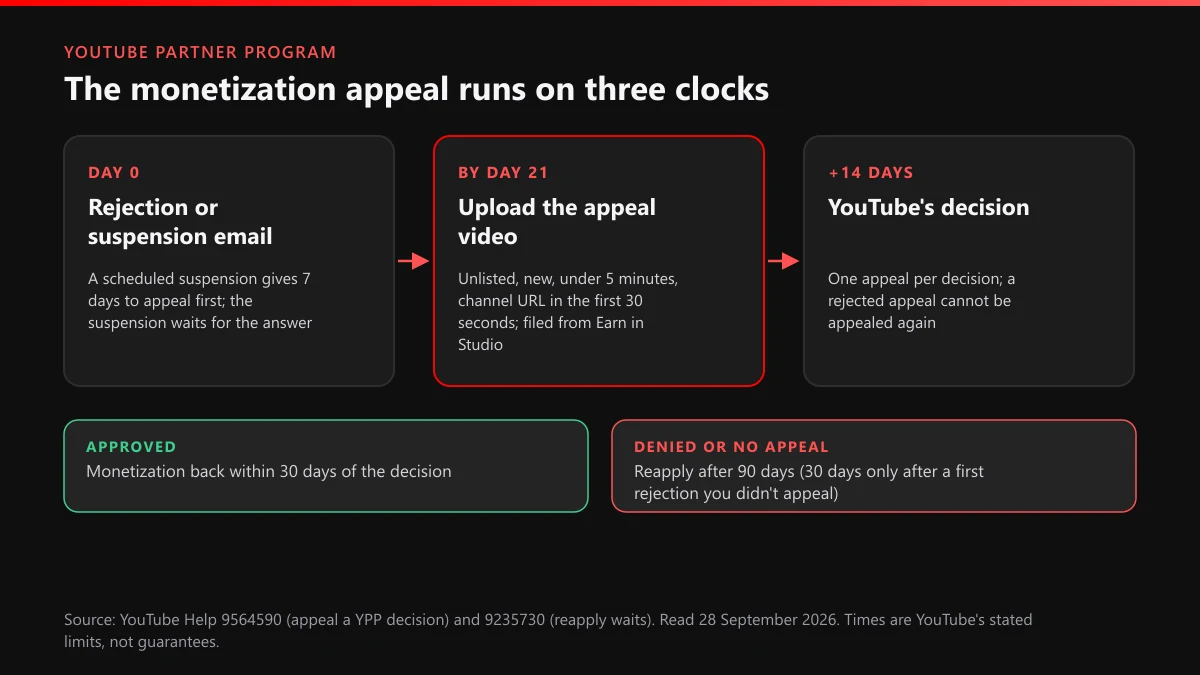
A YouTube monetization appeal is one short, unlisted video you file from the Earn tab in YouTube Studio within 21 days of a Partner Program rejection or suspension, or within 7 days if the suspension is only scheduled. YouTube answers within 14 days. You get one appeal per decision, and a no means waiting 90 days to reapply.
Which queue of the YouTube appeals process are you in?
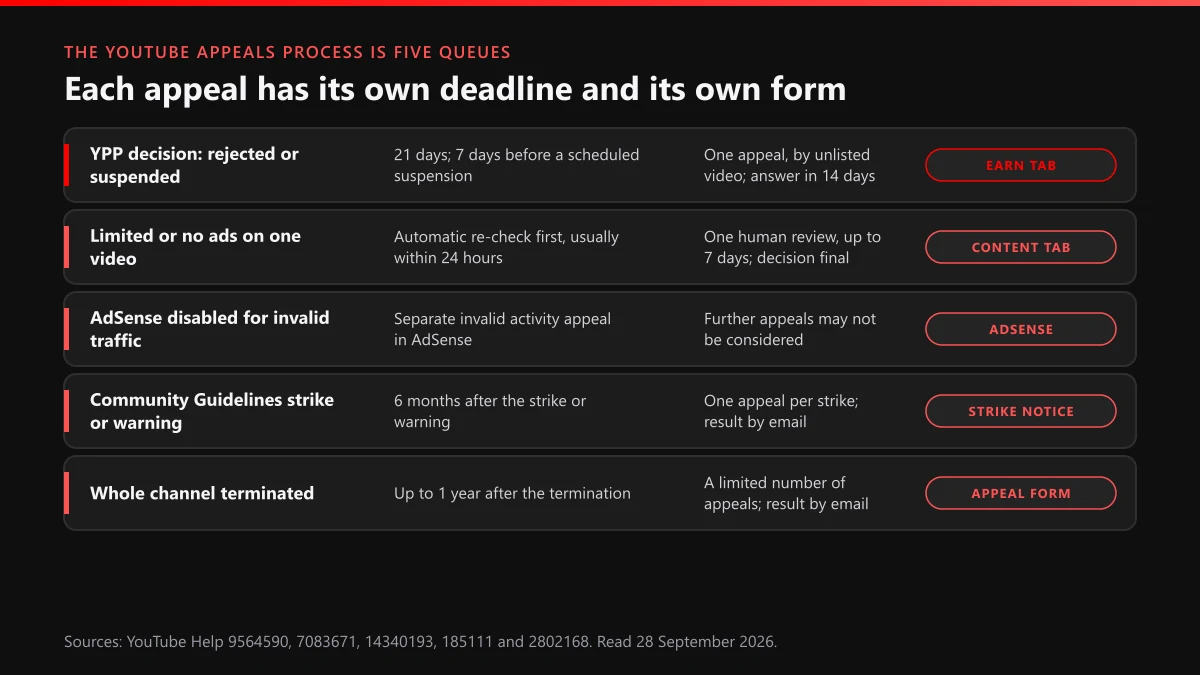
Check the notice before you record anything, because YouTube runs at least five separate appeal queues and none of them feeds into another. A Partner Program appeal won't lift a strike. A strike appeal won't restore ads on a channel that was rejected for reused content. And a channel termination sits outside both. People searching for "the YouTube appeals process" are usually looking at one of these five, so match the notice to its row first:
| What the notice says | Deadline to appeal | How many tries | Where it's filed |
|---|---|---|---|
| Partner Program application rejected, or monetization suspended | 21 days; 7 days if the suspension is only scheduled | One, by unlisted video | Earn tab in YouTube Studio |
| Yellow icon: limited or no ad earnings on one video | After YouTube's automatic re-check | One human review per video | Content tab, Notices column |
| AdSense account disabled for invalid traffic | Not stated | "Further appeals may not be considered" | AdSense invalid activity appeal |
| Community Guidelines strike or warning | 6 months after it was issued | One per strike | The strike notice in Studio |
| Channel terminated | Up to 1 year | A limited number, not published | YouTube's termination appeal |
Only the first row is a YouTube monetization appeal in the strict sense. The rest either cost you ads indirectly, by pulling a video or a channel, or cut the money off at the AdSense end. We sorted these rows from YouTube's own help pages on 28 September 2026, and one thing stood out: the queues don't just differ in deadline, they differ in who reviews. The yellow-icon review is described as "an expert looks at the video." The Partner Program appeal only promises that "our teams will respond." Keep the notice email. It names the queue, and the later steps quote its wording back to you.
How do you file a YouTube monetization appeal?
You record it. YouTube's Partner Program appeal help turns the whole appeal into a video, and the checklist is short and strict. It has to be "less than 5 minutes long," uploaded fresh as unlisted, and the appeal goes in the video only: "you should not put any appeal info in the description." Then:
- Open YouTube Studio on a computer and go to Earn, where the rejection or suspension notice sits with the appeal option.
- Record a new video under 5 minutes. Say your channel URL within the first 30 seconds and keep it on screen while you say it.
- Show how your videos are made: raw footage, project files, your voice recording, the script, whatever proves the work is yours.
- Walk through the policy the notice cites and point at the specific videos that answer it, by title.
- Narrate in a supported language, or add English subtitles you wrote yourself. Auto-generated captions don't count.
- Upload it as unlisted, leave the description free of appeal text, and submit that video from the Earn tab before the deadline.
- Watch the email address on the channel. The decision arrives there, usually inside 14 days.
Timing matters more than polish. If the suspension is only scheduled, YouTube says to "submit an appeal within 7 days before your scheduled suspension date," and monetization stays on while the appeal is reviewed. Miss that week and the suspension takes effect, and you're back to the 21-day window with ads already off.
What the appeal video should show
Proof of process, not a plea. The help page asks you to "provide visual examples of how your content was created," which is a request for evidence rather than a speech. A compilation channel that adds commentary should show the commentary being written and recorded. A Shorts channel built on stock clips should show the edit timeline and the licence. What doesn't help is thanking the reviewer, describing your subscriber growth or explaining how much the income means to you. None of that is on the reviewer's list. A tight structure works better: the channel URL first, then the policy named in the notice, then three minutes of screen recordings of the actual work, starting with the videos the reviewer is most likely to open.
What does a Partner Program reviewer look at?
The channel as a whole, sampled in a set order. YouTube's channel monetization policies, last updated 15 July 2025, list what a reviewer may check: "your channel's main theme, most viewed videos, newest videos, biggest proportion of watch time, video metadata (including titles, thumbnails, and descriptions), channel's 'About' section." A rejection email usually says "a significant portion of your channel does not meet our policies and guidelines," which is the channel-level test showing through. One good video in the appeal doesn't outweigh twenty weak ones in the grid.
Two policies cause most channel-level rejections. Reused content covers channels that "repurpose content that's already on YouTube or another online source without adding significant original commentary, substantive modifications, or educational or entertainment value." The second was called repetitious content until 15 July 2025, when YouTube renamed it inauthentic content to make clear it covers material that is "mass-produced, generic, repetitive, or manipulative." Faceless channels running the same template with a synthetic voice over stock footage are the usual target. Before you record the appeal, open your own channel signed out and look at the four things the reviewer sees first: the most viewed video, the newest one, the biggest watch-time source and the About text. If those four look like a template, fix them first.
That order also explains a common complaint: "they only looked at my old videos." They may well have. Most viewed and biggest watch time often point at uploads from years ago, so an early compilation that took off can sink a channel whose recent work is original. Unlisting those uploads before the appeal is allowed. Deleting them fixes nothing for a strike or copyright problem, as the monetization help says plainly.
Will YouTube reinstate my monetization?
Sometimes, and the rules tell you roughly when. If the appeal succeeds, YouTube's appeal page says the channel is re-approved "within 30 days." If it fails, "you cannot submit another appeal," and the reapplication rules take over: 30 days after a first rejection, and 90 days after later ones. A suspended channel also waits 90 days, according to YouTube's monetization-disabled help, and where the trouble was Community Guidelines or copyright, monetization can return after 3 months with no new issues.
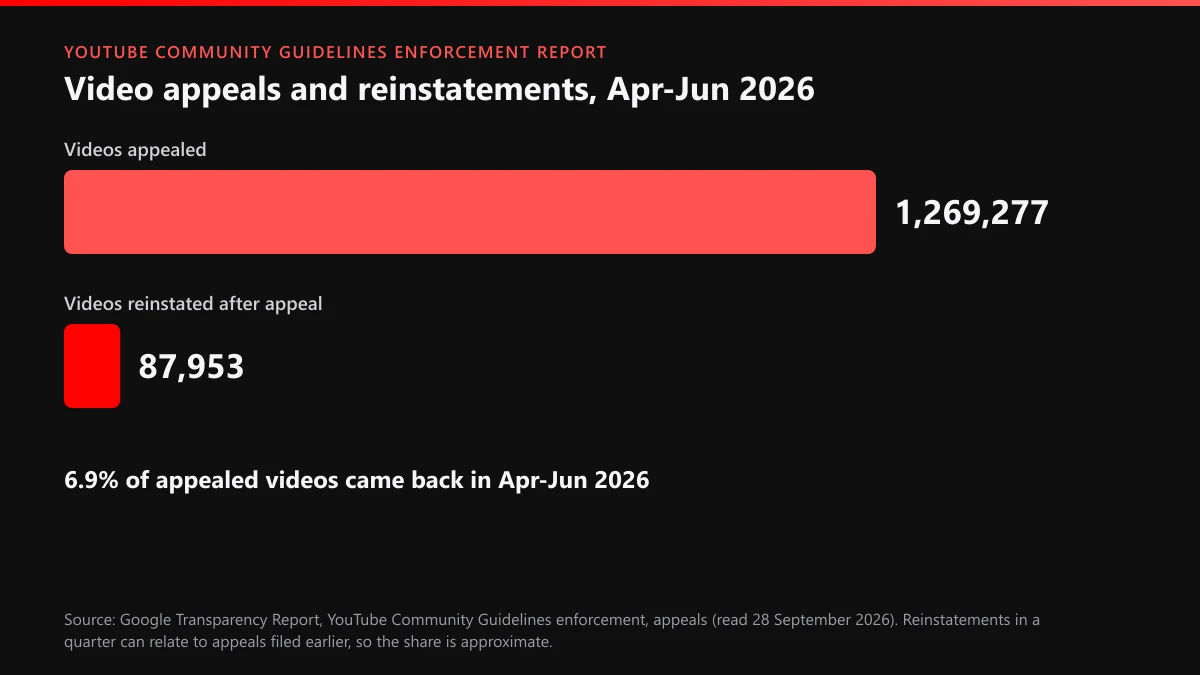
YouTube publishes no approval rate for Partner Program appeals. The nearest official figure covers video removals, not ads, but it shows how appeals tend to go. Google's YouTube appeals report counts 1,269,277 video appeals in April to June 2026 and 87,953 videos reinstated, around 6.9%. The same report says appeals go to "a different reviewer who did not make the original decision," so a second person does read them. Treat that 6.9% as a mood, not a forecast. A monetization appeal with real evidence of original work is a different case from a flat "please restore my video."
One date changes the maths for anyone suspended this year. On 10 August 2026 YouTube announced new entry thresholds: from 1 February 2027, "new creators applying for YPP will need 8,000 qualified watch hours in the last 365 days, or 20 million qualified Shorts views in the last 90 days," still with 1,000 subscribers. The current bar, per the Partner Program overview, is 4,000 hours in 12 months or 10 million Shorts views in 90 days. Channels already in the program aren't affected. A channel suspended in November 2026 and reapplying 90 days later, though, lands after the switch. That makes the one appeal you have now worth more than it was a year ago.
A quieter cause of lost monetization isn't a violation at all. YouTube "may turn off monetization on channels that haven't uploaded a video or posted to the Posts tab for 6 months or more." That isn't something you appeal. You start uploading again and reapply.
Can a yellow icon or an AdSense ban be appealed the same way?
No, each has its own button. A yellow dollar icon limits ads on one video, not the channel. Since 10 March 2025 those videos go through an automatic extra check "that may be completed by a human," usually within hours and at most 24. If the icon stays, you can ask for a review from the Content tab. YouTube's limited-ads help says the review "can take up to 7 days," and "after your one appeal, the reviewer's decision is final." Change the title and thumbnail before you ask, since the reviewer judges what's there now.
AdSense is further out of YouTube's hands. If Google finds invalid traffic, such as bought views or click farms, YouTube's invalid traffic help warns "we may disable your account," puts a 30-day payment hold in place, and bars the creator from opening new accounts. The only route is AdSense's invalid activity appeal, where you state that "you and anyone you're responsible for didn't directly or indirectly cause the invalid traffic." If a traffic seller or a rival's bot sent the views, say so and attach whatever records you have. After a decision, "further appeals may not be considered."
How to reinstate a YouTube account after a termination
Through the termination appeal, within a year. YouTube's terminations page says "creators have up to 1 year from the date their channel was terminated to submit an appeal," asks for a contact email and your reasons, and sends the result by email. It also warns that "there is also a limit on how many times you can appeal a single channel termination," without giving the number, so write the first one as if it's the only one. Our full walkthrough for a terminated-channel appeal covers the wording, and the explainer on what separates a terminated channel from a deleted one helps if you aren't sure which happened.
A YouTube account appeal and a Google Account appeal aren't the same thing. If Google disabled the whole account, you "can't sign in to Google services," and Gmail and Drive go with YouTube. That case is appealed from Google's sign-in screen, and Google's disabled-account help allows up to 2 appeals for some violations. It shows the limit before you submit. If that fails, the account stays "permanently disabled and considered for deletion."
If the appeal fails, there is now a door that didn't exist before October 2025. YouTube's second chances pilot lets some terminated creators request a new channel, but "not until one year after their termination date." The rejoining rules exclude copyright terminations, Creator Responsibility violations and anyone who deleted their own channel. Nothing carries over: no subscribers, no Partner Program status. You apply from scratch, under whatever thresholds apply that day. Don't try to shortcut the year with a spare channel. YouTube says terminated creators are "prohibited from using, possessing, or creating any other YouTube channels,", and the pilot is only open to creators who kept to that. The old handle is gone as well, and what YouTube will release of an old username is less than most people hope.
A channel recovery appeal after a hijack
If the channel was terminated because someone else took it over, order matters. YouTube's hacked channel help says "it's necessary to first recover the hacked Google Account," supports only incidents "within the past 9 months," and adds that you can appeal the termination "once you recover your Google Account." Filing the appeal from a login the intruder can still reach gets you nowhere. Recover, remove the hijacker's uploads and sessions, then appeal and describe the takeover with dates. The guide to reporting a hijacked or defamed channel lists the reports that run alongside the appeal.
Why the strike appeal matters more than the termination appeal
Because it comes earlier, and it's easier to win. Most terminations are three strikes inside 90 days, and each strike could have been appealed on its own. YouTube's strike appeal help gives 6 months per warning or strike, one appeal each, and three outcomes: the strike is removed, it stays, or the video comes back with an age restriction. The first violation is usually only a warning, and finishing the optional policy training lets it expire after 90 days.
When we checked the help pages side by side on 28 September 2026, we found two numbers that didn't agree. The strike appeal page gives 6 months, and a full year for removed content. The transparency report's own notes still say "creators have 90 days to submit an appeal after the video's removal." We went with the help page, since that's where the appeal is actually filed. The safe habit is simple: appeal inside 90 days anyway and you're inside every version of the rule.
Copyright strikes aren't appealed at all. They expire after 90 days if you complete Copyright School, or they go away if the claimant retracts or you file a counter notification when the content was fair use or removed by mistake. Our explainer on how YouTube copyright strikes work covers all three, and YouTube's copyright strike basics hold the same terms. A counter notification against a real rights holder is a legal statement, so file one only when the use really was yours to make.
Is there an outside appeal if you're in the EU?
Yes, after YouTube's own appeal. The Digital Services Act lets EU users take a moderation decision to a certified out-of-court body. Appeals Centre Europe lists YouTube among its platforms and says "there is currently no user fee to submit a dispute." Its rulings aren't binding, and YouTube hasn't made it easy. In its first report, covered by France 24 on 1 October 2025, the centre said YouTube had 343 eligible disputes but supplied content for only 29 and called it the worst culprit. That doesn't make it useless. A written finding that a removal was wrong is something to quote in your next reapplication or termination appeal.
Who is selling "monetization reinstatement"?
Plenty of people, and none of them has a line into YouTube. The pitches run from appeal-writing packages to "insider" reviews that promise ads back in days. Every route on this page is free and filed from your own Studio, and no outside party can file a Partner Program appeal for you, because the appeal is a video of you showing your own work. Anyone asking for your Google password, a sign-in code or access to Studio "to handle the review" is asking for the same access a hijacker wants. Our look at what YouTube ban-service panels actually deliver shows how those deals tend to end.
The same sellers often offer the reverse: mass reports aimed at a competitor's channel. Coordinated false flags are counted and discounted, as the breakdown of why YouTube mass-report bots don't work explains, and the same trade on Instagram appears in our notes on Instagram mass report tools and spam report bots for Instagram accounts. A channel that really breaks the rules comes down through one accurate report. The method is in reporting a rule-breaking channel the proper way, and what a channel report actually reviews tells you which option to pick.
There's a second reason to watch other channels while your appeal is pending: copies of your own work. Your videos re-uploaded elsewhere, your thumbnails cloned, a lookalike channel under your name. Those are yours to report as the owner. The stolen-video takedown order sets the sequence, filing a copyright removal request covers the form, and getting one video taken down handles the upload that can't wait. For whole channels, see taking down a copycat channel, and for fake merch or brand misuse, counterfeit and trademark complaints.
Scam comments aimed at creators who are waiting on an appeal ("DM me, I work at YouTube") follow the steps for reporting reuploads and scam comments. Paid ads promising reinstatement go through reporting YouTube scam ads, and a video selling it through the standard video report. Reports are anonymous, and what happens after you flag a video covers the review side. On your own channel, hiding a user from your channel keeps those accounts out of your comments while the appeal runs.
YouTube Ban Service doesn't file monetization appeals and never needs a client's login. We handle the other side: copied uploads, impersonators and scam channels circling a creator, reported through YouTube's own copyright, impersonation and spam routes, with YouTube making every decision. A channel that breaks no rule, such as a commentary channel that quotes you fairly, is one we leave alone. If that's your problem, send the channel link through our contact page. Our YouTube content removal service explains what we take on, and the full set of YouTube guides covers the rest.
FAQ
How long does a YouTube monetization appeal take?
YouTube says its teams respond within 14 days of the appeal video. If the answer is yes, the channel is re-approved for the Partner Program within 30 days, so the whole run from filing to ads can take about six weeks.
Can I appeal a YPP rejection twice?
No. YouTube allows one appeal per decision and says that after a rejected appeal you cannot submit another. The next step is a fresh application once the waiting period ends, which is 90 days after a denied appeal or a suspension.
Do I lose my earnings while monetization is suspended?
You stop earning from ads and fan funding while the channel is outside the Partner Program. If you appeal within 7 days of a scheduled suspension notice, the suspension is paused until YouTube decides. AdSense closures for invalid traffic add a separate 30-day payment hold.
Will deleting the flagged videos get my monetization back?
Not for strike or copyright problems. YouTube's monetization help says deleting the video will not fix Community Guidelines or copyright issues. For reused or inauthentic content, what counts is how the channel as a whole looks when a reviewer checks it again.
Can I just start a new channel and monetize that?
No. YouTube says suspended creators should not create new channels or use existing ones to get around monetization restrictions, and a terminated creator is barred from any other channel. The second chances pilot is the only sanctioned route, one year after termination.
Does the 2027 threshold change affect my reapplication?
It can. From 1 February 2027, new applicants need 8,000 watch hours in the last 365 days or 20 million Shorts views in 90 days, plus 1,000 subscribers. A channel suspended now and reapplying after that date would meet the higher bar.
Is a YouTube account appeal the same as a Google Account appeal?
No. A terminated channel is appealed through YouTube within one year, with the result by email. A disabled Google Account locks every Google service and is appealed from the Google sign-in screen, where some violations allow up to 2 appeals.
Can I appeal an age restriction on a video?
Yes, once. YouTube's age-restriction help says you can only appeal the age restriction on your video one time, from the Notices column in the Content tab. Age-restricted videos reach fewer viewers and may get limited or no ads, so income usually drops.