22 September 2026 · YouTube Ban Service · ~14 min read
How a YouTube copyright takedown request works when your videos are stolen
A YouTube copyright takedown request is a sworn legal notice asking YouTube to remove stolen copies of your work, one link per copy. File it in YouTube Studio with proof the original is yours. An accepted request can put a copyright strike on the uploader, and three strikes in 90 days leave their account open to termination.
Four doors into YouTube's copyright system, and who used them in 2025
Almost every copyright action on YouTube in 2025 went through Content ID: 2,502,941,368 claims, or 99.48% of the year's total, according to YouTube's Copyright Transparency Report for January to December 2025. Most creators whose videos get stolen will never touch that system, because only 7,626 accounts held access to it. For everyone else, two doors matter. Public webform traffic came to 2,969,817 removal requests from 295,531 users. Match Tool users sent 4,478,219 requests from 173,338 channels, out of the 4,102,721 channels that could have opened it by December.
| Route | Accounts with access, Dec 2025 | Used it in 2025 | Claims or requests in 2025 | Share of all copyright actions |
|---|---|---|---|---|
| Content ID | 7,626 | 4,454 | 2,502,941,368 claims | 99.48% |
| Enterprise Webform | 8,373 | 2,424 | 5,606,154 requests | 0.22% |
| Copyright Match Tool | 4,102,721 | 173,338 | 4,478,219 requests | 0.18% |
| Public webform | Open to anyone (YouTube's figure is "billions") | 295,531 | 2,969,817 requests | 0.12% |
The quality gap between the two doors matters more than the volume. Of the requests filed through the public webform, 85.81% ended in removal, while 6.44% were classed as abusive and 6.65% as invalid. Requests sent from the Match Tool were removed more often and judged abusive far less often: 90.37% removed and 0.89% abusive, though 8.59% were invalid. Disputes split the same way. More than 9% of webform requests drew a counter notification, against 3% or less for the Match Tool and the Enterprise Webform, per the report's section on abuse and disputes.
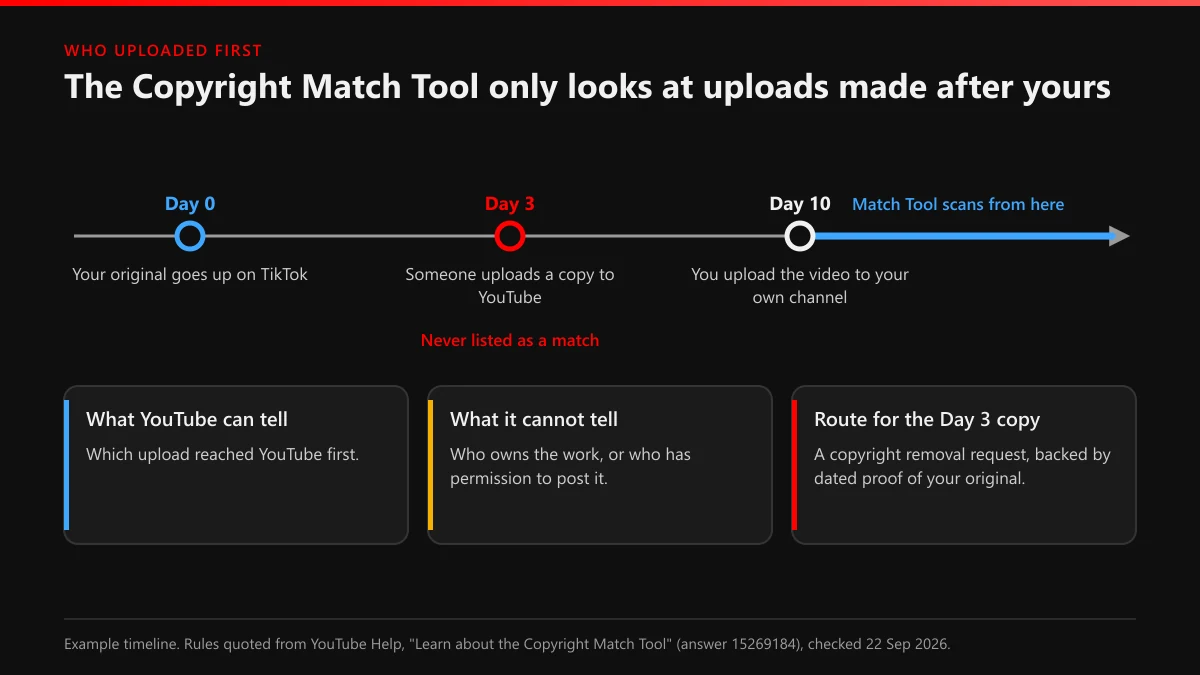
Part of the reason is mechanical: the Match Tool only shows you copies of videos you were first to put on YouTube, which leaves little room to claim somebody else's work through it.
Is it copyright infringement on YouTube, or a copy you can't touch?
It is infringement when someone republishes your footage, audio, artwork or script without permission; borrowing your idea, format or title is not. Reposting another creator's video to grow your own channel even has a name, freebooting, and the copies rarely arrive untouched. Expect mirrored frames, crops that cut off your watermark, footage sped up a few percent, a new voiceover or AI narration laid over your pictures, and compilation channels that stitch dozens of creators' clips into one upload. Every one of those still reproduces your work. So does a Short cut from something you posted on TikTok or Instagram, and so does your track playing under somebody else's slideshow.
One kind of copying you licensed in advance. YouTube's Terms of Service give every other user a licence to use your uploads in the ways YouTube's own features allow, which covers embeds and remixes. With the Cut tool, a creator can lift a 1 to 5 second segment of an eligible video into a new Short. That is a setting, not a theft: each video in YouTube Studio has a Shorts remixing option, and Shorts are opted in to remixing by default.
Commentary is the hard middle. A reaction channel that stops your video every few seconds to argue with it may be protected by fair use under US law, and a request against it is the kind most likely to come back as a counter notification. Weigh that before filing, because the sworn statement you sign includes a good-faith belief that the use is not authorised.
A copy of your face is a different problem from a copy of your video. When an upload uses AI to generate or alter your face, YouTube treats it as a privacy matter through likeness detection, an experimental tool rolled out to Partner Program creators in late 2025; real footage of you, reposted without permission, goes back to a copyright request. Deepfakes and account hijacks are handled in the guide to reporting hijacking, defamation and deepfakes, and knock-off merchandise sold under your name belongs in a counterfeit report rather than a copyright one.
Clips of you re-cut into a scam advert are theft and fraud at once, and the advert itself has its own scam ad reporting route.
When the thief reached YouTube before you did
A stolen copy that reached YouTube before your own upload will never appear in the Copyright Match Tool. It scans only videos uploaded after yours, and YouTube lists not being first to upload among the reasons a video goes unscanned. Its help page on the tool is candid about the limit: YouTube can tell which upload came first, not who owns the work or who had permission to post it.
Creators who publish on TikTok or Instagram first lose ground here without knowing it. According to the transparency report, the tool only needs you to be the first to upload a video to YouTube, and that first upload can be public, private or unlisted.
A private copy on your own channel, posted the day an original goes live elsewhere, costs nothing and puts every later copy in front of the tool.
For a copy that beat you to YouTube, the removal request is the route, and the weight falls on your evidence. YouTube's instructions ask for a clear and complete description of the work, and they do not say the original has to be on YouTube. Before YouTube Ban Service files anything for a copy like this, it asks the client for:
- the master export or camera file, with its creation date intact
- the project file from your editing software, which a thief holding a downloaded copy cannot produce
- the link to your original post, where TikTok, Instagram or your own site shows the date
- raw footage or alternate takes that never went online
- screenshots of the stolen upload showing its date, title and channel name
Most of that folder never goes to YouTube. It lets you describe the work precisely, and it is what you will need if the uploader disputes the request.
If the same account also copies your name, avatar or @handle, copyright alone won't stop it. The impersonation and trademark routes for a taken name sit in the guide to claiming a YouTube username.
How to file a DMCA takedown on YouTube: the removal request form, copy by copy
Sign in to YouTube Studio, open the copyright section and start a new removal request that lists each stolen copy by its own link. People search for it as the YouTube DMCA form or a copyright takedown form; inside Studio it is a button, and the steps don't change with the name.
- List every copy. Take the watch or Shorts link of each stolen upload, and note where your footage runs inside it when only part of your video was used.
- Open the form. In YouTube Studio, go to Content detection, then Removal requests, and click New removal request. Some of YouTube's help pages still call that menu Copyright; it is the same place.
- Describe your work. Say what the original is, when and where you published it, and what was taken. YouTube can send an incomplete request back and ask for a more specific title.
- Choose the timing. Leave the request unscheduled and the copy comes down once YouTube approves it. Schedule it and the uploader gets 7 days to delete the copy and avoid a strike.
- Decide on Prevent Copies. The box reads "Prevent future copies of this content from appearing on YouTube." Tick it only if you control the work's distribution worldwide, because it cannot be added to the request afterwards.
- Sign and submit. The legal statements and the signature need your full legal name, not a company name. Until YouTube has all the information it needs, the stolen copy can stay up.
Studio only takes video links. Channel banner images and other non-video material go to YouTube by email at [email protected], by fax or by post, as the removal request help page explains. The individual fields, the sworn statements and what the uploader learns about you are covered in the copyright removal request guide.
Only the owner, or someone authorised to act for them, may file. YouTube Ban Service files in that second capacity for creators who would rather not handle the form themselves, which is what the YouTube content removal service page describes.
One notice, one link: what the Athos ruling means for reuploads
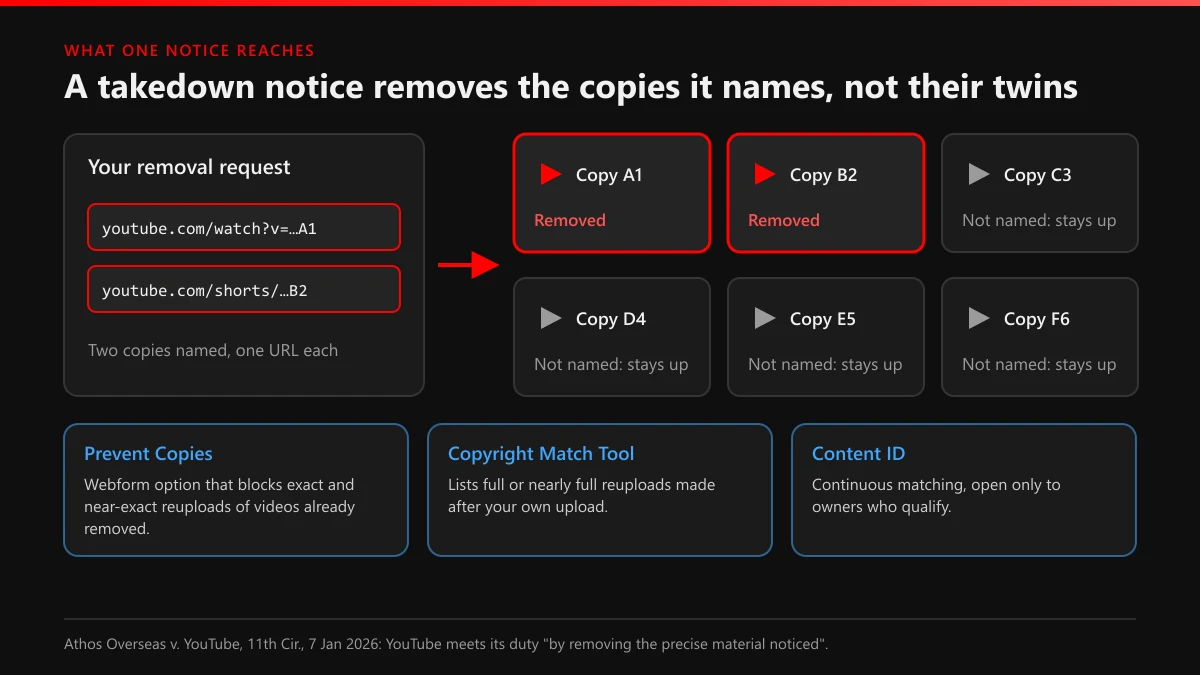
YouTube only has to remove the copies a notice names, and a federal appeals court confirmed it on 7 January 2026. Athos Overseas, which owns classic Mexican and Latin American films, argued that once it told YouTube where one infringing copy sat, YouTube's hash-matching technology gave it knowledge of every identical copy on the site. The Eleventh Circuit rejected that in Athos Overseas v. YouTube, holding that "the simple accumulation of adequately-addressed DMCA takedown requests alone cannot amount to red flag knowledge" of other infringement. Removing the precise material noticed is enough.
What matters for creators sits in the court's account of the record. It listed three hash-matching tools YouTube offers: Content ID, the Copyright Match Tool, and the Prevent Copies function of the copyright webform. All three depend on input from the rights holder, which the court accepted YouTube could not supply alone. Athos had been offered the tools and turned them down, calling the required user agreement "monopolistic and abusive", then paid a law firm to hunt for copies by hand.
For a creator up against a catalogue thief, the lesson is practical. Every copy you want gone needs its own link, and YouTube's form will not accept a request aimed at a whole channel or playlist. Ticking Prevent Copies on the first request, then working through the Matches tab in the Copyright Match Tool, is how later copies get caught without you finding each one yourself. YouTube Ban Service ticks that box on a client's first request whenever the client controls the work worldwide. Each match is surfaced only once, so a match you ignore will not be shown again.
None of this runs through the three-dot flag. The difference between flagging a video and filing for it is set out in the guide to reporting a YouTube reupload.
How to copyright strike a YouTube channel that keeps stealing
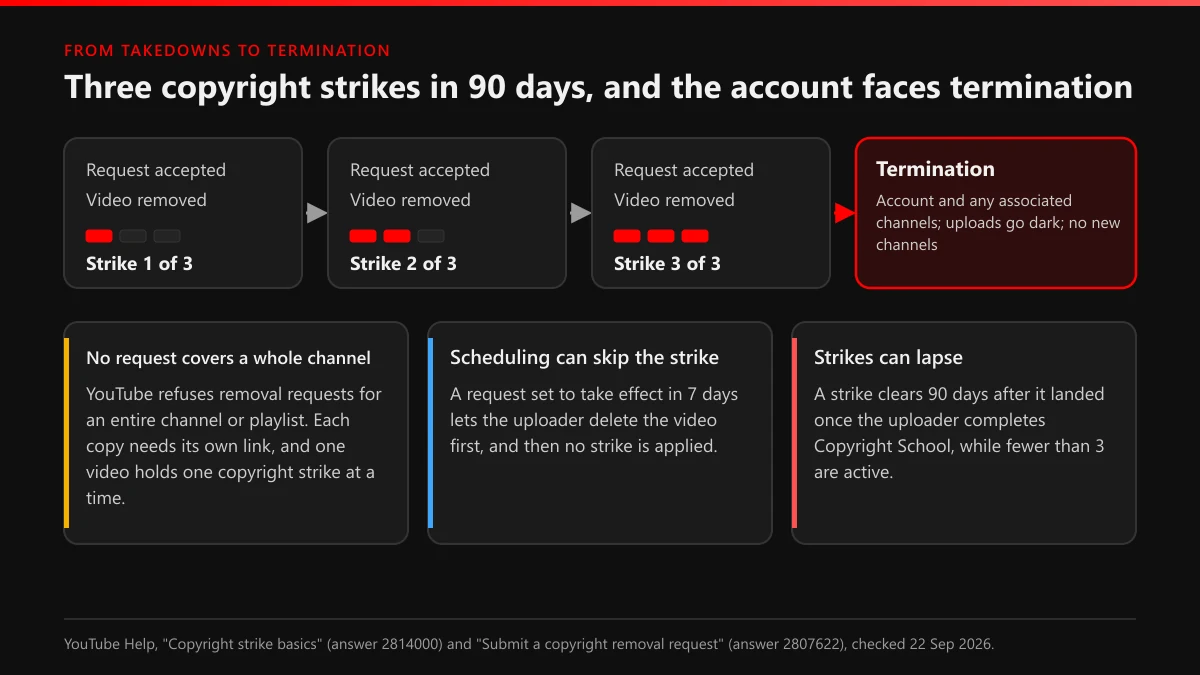
No single request strikes a channel; strikes land one accepted request at a time, and three active ones endanger the whole account. YouTube's copyright strike rules make a channel with 3 copyright strikes in 90 days subject to termination, along with any associated channels, and its owner cannot create new ones. When a linked channel reaches 3 active strikes, the channels tied to it are exposed as well.
Can you give someone a copyright strike, or only send a removal request?
Only the request. Nobody can give someone a copyright strike directly, and there is nothing to send except the removal request itself. YouTube applies the strike when it accepts the request, and a video carries only one copyright strike at a time, however many requests name it. One strike can also cover several videos taken down together, which is why YouTube's retraction rules mention other videos associated with the same strike.
That turns the timing box into a strategic choice. A request scheduled for 7 days lets the uploader delete the video and walk away without a strike, the fair option for a fan who reposted once. Against a channel built on other people's uploads, YouTube Ban Service leaves the request unscheduled, because that option gives the uploader no way to dodge the strike.
The three-strike rule is YouTube's answer to a legal condition. To keep its safe harbour, a platform must adopt a policy that provides for "the termination in appropriate circumstances" of repeat infringers, under 17 U.S.C. §512(i)(1)(A).
How to report a YouTube channel for copyright when every upload is yours
Report the uploads, not the channel. Flagging the channel is the wrong door, because YouTube takes copyright complaints from the owner through removal requests, so a catalogue thief means one request per stolen video, filed in batches as you find them. What the thief's channel looks like after termination is explained in terminated or deleted channel statuses, and routes that remove a channel for reasons other than copyright are compared in YouTube channel takedown routes.
A thief terminated for copyright infringement also loses a door that other banned creators keep. YouTube is piloting a way for some terminated creators to request a new channel after a one-year wait, and the pilot excludes anyone terminated for copyright infringement. Its circumvention rules already bar a terminated user from using or creating other channels, so a fresh channel reposting the same videos calls for a report and a new set of requests.
Report counts never substitute for an accepted request. That is why an Instagram mass report tool removes nothing, and why a spam report bot fails on the same arithmetic. The strike itself, its expiry and how it differs from a claim have their own YouTube copyright strike guide.
How to copyright claim someone on YouTube and take the ad money
Taking a thief's ad money needs Content ID, and only 7,626 accounts had access to it at the end of 2025. A Content ID owner picks a policy for each match: block the video, run ads on it, or track its audience. Owners chose to monetise more than 90% of Content ID claims in 2025. Neither the Match Tool nor the public webform can do any of that. They remove, or they do nothing.
Creators who fall short of Content ID's bar, which YouTube frames around owning exclusive rights to a large body of original material that users upload often, can still reach it through third-party service providers that manage rights for a fee. The Match Tool offers one middle path of its own, a pre-written email to the uploader, which suits a case where credit or a licence fee would settle things.
What if the thief files a takedown against your original?
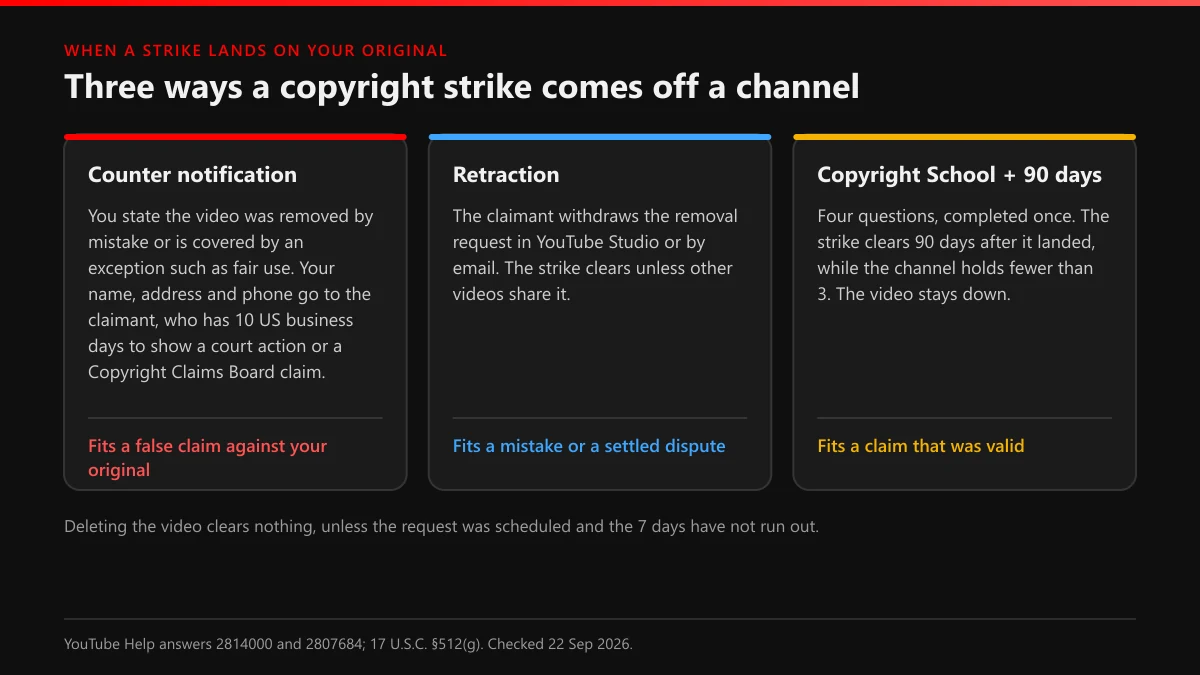
A takedown filed against your original puts the strike on your channel, and it comes off through a counter notification, a retraction, or Copyright School plus 90 days. False ownership claims are not rare on the public webform: YouTube's report says more than 6% of the videos targeted through it in 2025 were the subject of abusive requests. Its warning to filers is blunt, too. Misusing YouTube's copyright tools can cost the filer their own account.
| Exit | Who acts | What it costs you | Does the video come back? |
|---|---|---|---|
| Counter notification | You, citing a mistake or fair use | Your contact details reach the claimant; you accept US jurisdiction | Yes, after 10 US business days, unless they sue or file with the Copyright Claims Board |
| Retraction | The claimant, in Studio or by email | Only the effort of persuading them | Yes, unless you deleted it; the strike clears unless other videos share it |
| Copyright School and 90 days | You, once: four questions | The strike stays 90 days, and clears only if you hold fewer than 3 | No |
The evidence folder that supports your takedowns is also your defence here. A counter notification is a statement under penalty of perjury, filed through YouTube's counter notification process, so send one only when you can show the work is yours, and expect the claimant to see your contact details. Deleting the video does not clear a strike that has already landed. The one case where deleting helps is a scheduled request, and only inside its 7 days.
Copyright School does not bring the video back when the strike expires, which makes it the right exit only when the claim against you was valid. If someone is also mass-flagging your uploads for policy reasons, that side runs through the ordinary flag system, and how to report a YouTube video shows what those reports can and cannot reach.
What YouTube Ban Service checks before a stolen-video takedown goes in
YouTube Ban Service starts every stolen-video case with two questions: can the client prove the work is theirs, and was the copy posted without permission? Collaborations are the usual trap. A co-creator who holds rights in the same video can post it without infringing anything, and a request against them would be false. After ownership and permission come fair use for anything with commentary, the timing choice, and Prevent Copies, which only suits a client who controls the work worldwide.
When we pulled YouTube's 2025 copyright figures for this page, we saw that the gap between access and use was the number worth repeating: 4,102,721 channels could open the Copyright Match Tool, and 173,338 did. We also went through the Athos opinion, since it sets out on the record what each of YouTube's matching tools needs from the rights holder.
We turn down cases where the copy is a reaction or review that fair use could plausibly cover, where the client licensed the video and now regrets it, where only an idea or a title was taken, and any request against a channel that has permission to use the work. Filing those would put the client's own account at risk. Thieves sometimes turn up in your comments after a takedown; hiding a user from your channel handles that without another report. For videos that break YouTube's rules but copy nothing of yours, getting a YouTube video taken down starts from the report side, and the full set of YouTube reporting guides covers the rest.
If your videos are being stolen right now, start with the evidence folder, upload private copies of anything you publish elsewhere first, and file the request for each copy unscheduled, with Prevent Copies ticked. Send the links through the contact page if you want the file checked before anything is signed.
FAQ
Can I take down a YouTube reupload of a video I only posted on TikTok?
Yes. YouTube's instructions ask you to describe your work clearly and completely, and they don't require the original to live on YouTube. Link the TikTok post, keep the original file with its creation date, and don't wait for the Copyright Match Tool, which only tracks copies uploaded after your own YouTube upload.
How many stolen videos can one takedown request cover?
YouTube publishes no number, and one request can remove several videos as long as each copy has its own link. What the form refuses is a request aimed at an entire channel or playlist, so a catalogue thief means a long list of links.
Will YouTube catch a flipped, cropped or sped-up copy of my video?
Not reliably. The Copyright Match Tool looks for full or nearly full reuploads and can miss short clips. Prevent Copies targets exact and near-exact copies of videos you already had removed, and heavy edits can slip past it. Anything neither system flags comes down the ordinary way, once you find it and give it its own request.
Can a copyright complaint cover a stolen channel banner or profile picture?
Yes, but not through YouTube Studio, which only accepts video links. YouTube takes non-video content, channel banner images among it, by email to [email protected], by fax or by post. The same ownership rules apply: the image has to be yours, and the notice carries the same sworn statements.
Can I submit a DMCA takedown notice without a YouTube channel?
Yes. YouTube accepts removal requests for videos by email, fax or post as well as through YouTube Studio, and its instructions for those routes say nothing about owning a channel. Studio itself needs you signed in. Whatever the route, the notice must identify the work, link each copy and carry your signature.
What happens if the thief's account is terminated and a new channel appears?
That breaks YouTube's circumvention rules, which bar a terminated user from using, owning or creating other channels. Report the new channel and file fresh requests for every copy it posts. Someone terminated for copyright infringement is also shut out of YouTube's pilot that lets some terminated creators ask for a new channel after a year.
Can I remove my takedown and its strike if we reach a deal?
Yes. In YouTube Studio's Removal requests tab you can retract a removal, or retract a request still waiting out its 7 days, and email retractions must come from the address you filed with. The strike clears unless other videos share it, and the video returns unless the uploader deleted it. YouTube won't withdraw the strike alone.
Is a fan reupload that credits me still infringement?
Yes. A credit line is not permission, and copyright is your right to decide who republishes the work. For a fan who reposted once, a scheduled request or the Match Tool's pre-written email to the channel gives them a way out without a strike on their account.