1 October 2026 · YouTube Ban Service · ~16 min read
Harassment on YouTube: the policy, the forms, and who decides
YouTube's harassment policy bans content aimed at an identifiable person: prolonged insults about intrinsic traits, threats, doxxing, stalking, unwanted sexualization and pile-ons the uploader encourages. It doesn't rule on whether a claim is true. False statements go through a separate legal defamation complaint, and blackmail is a crime to take to police before you press Report.
How often does YouTube act on harassment and defamation notices?
Often for harassment, rarely in the way people hope for defamation. Flags first: in April to June 2026, viewers sent YouTube 82,393,855 flags, and 15,567,233 of them were for hateful or abusive content, according to Google's YouTube Community Guidelines enforcement report. Yet of the 11,159,676 videos YouTube removed that quarter, only 123,855, about 1.1%, were first spotted by a user flag. Automated systems caught 98.6%.
The EU's DSA Transparency Database shows the legal side, because YouTube has to log each EU decision there, and it pastes the email the uploader received into the record. When we worked through YouTube's records for 1 May to 30 September 2026 on 1 October, the split was lopsided. Notices YouTube filed as cyber violence came to 891 (the sample records give the legal ground as "Harassment Complaint"), and 605 of those ended with the content removed. Notices filed as illegal or harmful speech, where defamation and national hate-speech laws sit, came to 19,321, and 19,136 of them ended with the video blocked in one country only. The sample German defamation email told the uploader: "We haven't applied a strike to your channel, and your content is still live on YouTube." Across both categories, not one account was terminated.
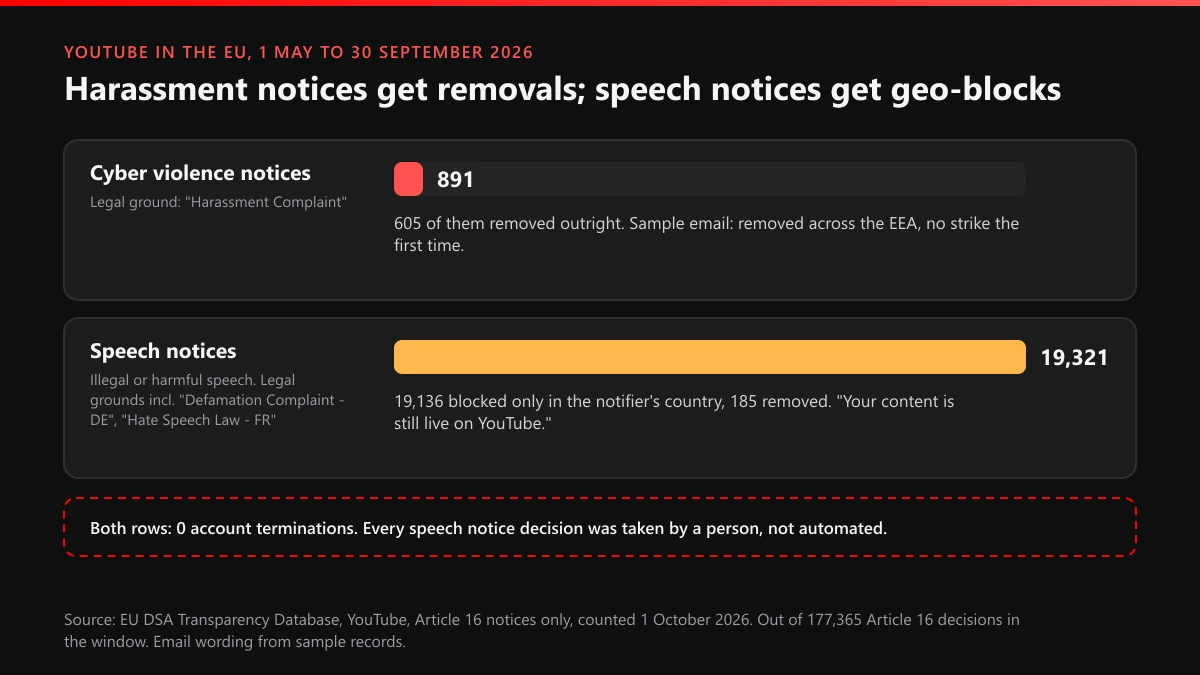
Read that as a map, not a scoreboard. A harassment report asks YouTube to apply its own rules worldwide. A defamation complaint asks it to apply one country's law, so the usual result is a block in that country while the video stays up everywhere else.
Which rule, form or court fits what was posted about you?
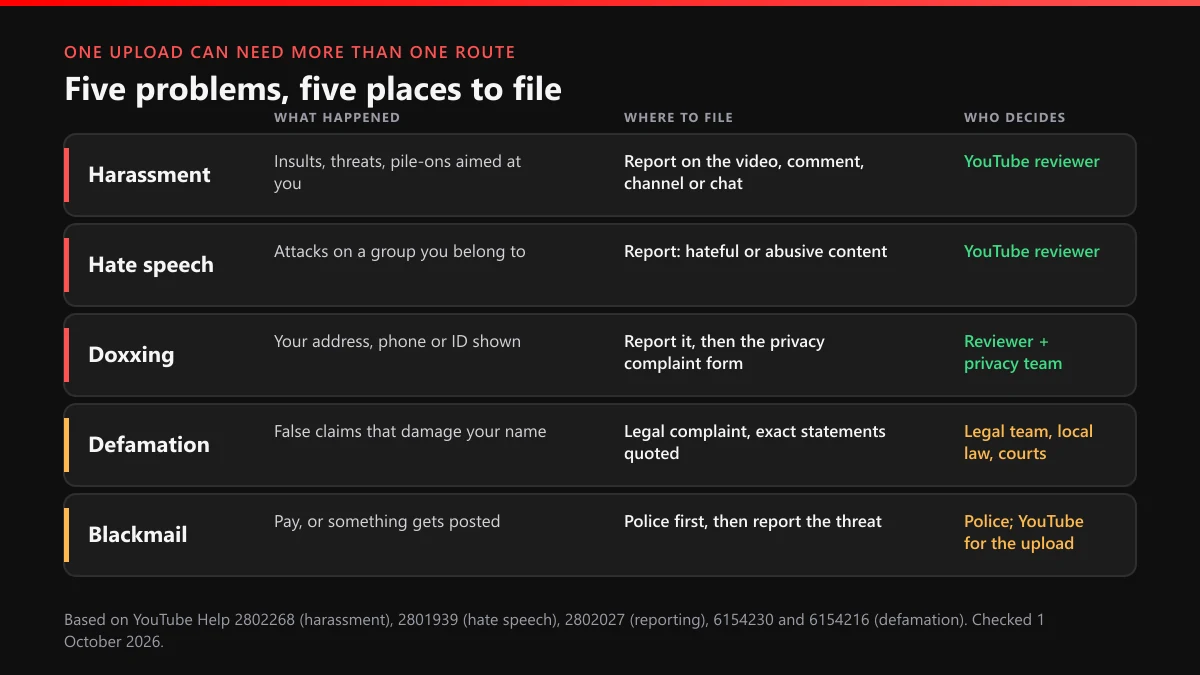
Sort by what the content does to you, not by how angry it makes you. YouTube runs four separate decision tracks for this family of problems, and the fifth sits outside YouTube entirely.
| What happened | The rule it breaks | Where to file | Who decides |
|---|---|---|---|
| Insults, threats, stalking or a pile-on aimed at you | Harassment and cyberbullying policy | Report on the video, Short, comment, channel or live chat | A YouTube reviewer |
| Attacks on you because of your religion, race, disability or another protected group | Hate speech policy | Report, using the hateful or abusive reason | A YouTube reviewer |
| Your home address, phone number, ID or a child's school shown | Harassment policy (personal information) and privacy guidelines | Report, then the privacy complaint form | A reviewer, then YouTube's privacy team |
| False statements that damage your reputation | National defamation law, not the Community Guidelines | The defamation complaint form, or a court order | YouTube's legal team under local law; ultimately a court |
| "Pay me or this goes up", fake strikes for money, sextortion | Criminal law, plus the harassment policy's ban on blackmail | Police first, then a report on the upload or message | Police; YouTube only for the content |
Several rows can apply to one upload. A video that calls you a fraud, shows your street and tells viewers to "pay you a visit" breaks the harassment policy twice and may defame you as well. File the fast track first, the flag, and keep the slow legal track running beside it. If the problem is a single upload, our guide to getting one video taken down covers that narrower job; when a whole channel exists to target you, a whole-channel takedown is the better frame. Impersonation is a different policy again, and if the harasser has grabbed a handle that mimics yours, claiming back a YouTube handle runs on its own rules.
What does the YouTube harassment policy actually ban?
Content that targets an identifiable person, wherever on YouTube it appears. The harassment and cyberbullying policy applies to "videos, video descriptions, comments, live streams, and any other YouTube product or feature", and to external links, including a creator verbally sending viewers to another site. The list it publishes is longer than most people expect:
- prolonged insults or slurs aimed at someone's intrinsic attributes, which the policy defines as protected group status, physical attributes, or status as a survivor of abuse;
- content meant to shame, deceive or insult a minor, meaning anyone under 18;
- sharing, threatening to share, or encouraging others to share someone's non-public personal information;
- brigading, which YouTube defines as encouraging "the coordinated abuse of an identifiable individual on or off YouTube";
- threats against a person or their property, including implicit ones with no time or place that show a weapon;
- stalking, unwanted sexualization, and reveling in or mocking someone's death or serious injury;
- staged "catch a predator" meet-ups without police present, and vigilantes restraining people or chasing them by car;
- realistic simulations of dead or abused people describing what happened to them;
- targeting someone as part of a harmful conspiracy theory, or denying that they were a victim of a documented violent event.
Enforcement follows YouTube's standard ladder, set out on its strikes page. A first violation is usually a warning, which expires 90 days after the creator completes an optional policy training. After that, a first strike freezes uploads for a week, a second for two weeks, and three strikes inside 90 days can end the channel. A single case of severe abuse can terminate a channel without any warning at all. If you later need to know whether a channel that vanished was punished or just closed by its owner, our note on telling a terminated channel from a deleted one explains the signs.
Where does criticism end and harassment start?
At the person and the pattern. YouTube's policy keeps three exceptions: debate about "individuals who have positions of power", scripted performances such as satire, stand-up or music, and content made to educate people about harassment. A video saying a creator's course is overpriced is criticism, even when it's rude. Ten uploads mocking that creator's stammer are something else, and the policy's own examples name a channel that targets someone "across several uploads". The rule against insulting people over protected attributes has, since YouTube's 11 December 2019 policy update, applied "to everyone, from private individuals, to YouTube creators, to public officials". The same update said channels that "repeatedly brush up against" the policy lose Partner Program earnings. In practice this means a lone flag on the mildest clip tends to fail, because the reviewer sees one video and no campaign. A channel report that lists several timestamped uploads shows the pattern the policy describes, and our breakdown of what reviewers check in a channel report shows how that review differs from a video flag.
How do you report YouTube harassment on a video, comment, channel or live chat?
From the content itself, signed in, using the three-dot More menu. There is no standalone harassment webform; the reporting help page sends every surface through Report, and it says reporting "is anonymous, so other users can't tell who made the report."
- Video or Short. Open More below the player, or at the top right of a Short, choose Report, pick the harassment or bullying reason, and use the details box for the timestamp where it starts.
- Comment. Open More beside the comment and choose Report. On your own channel, tick "Hide user on my channel" in the same step.
- Channel. Open the channel, click "…more" in the description, then Report user. Pick the matching reason and name the worst videos.
- Live chat. Hover over or tap the message, open More, then Report. As the streamer you can also block the viewer from your chat.
- Community post. Open More at the top right of the post and choose Report.
Video reports can be tracked at youtube.com/reporthistory on a computer. The full click-by-click version is in our video-reporting walkthrough, and what happens after you press Report explains the statuses you'll see. Comment floods and copies of your own clips used against you are covered in reporting abusive comments and re-uploads. If you run the channel being targeted, YouTube's Hide user tool removes that person's comments and chats from your channel without telling them, and our page on blocking someone from your own channel walks through it in Studio.
One accurate report carries more weight than a hundred copies. YouTube's published flag data leaves out "suspicious or exceptionally high flagging volumes", which is one reason a mass-report bot adds nothing to a harassment review and why ban-service bots and report panels mostly sell noise. The same holds when a harassment campaign follows you to Instagram: Instagram spam-report bots and Instagram mass-report tools get reports discounted rather than accounts removed. And if the other side retaliates by reporting your channel and a strike lands, appealing a strike or ban you think was wrong is free and separate.
Is hate speech reported the same way as harassment?
Same button, different reason, different policy. Harassment targets a person; hate speech targets people because of a group they belong to. YouTube's hate speech policy protects groups defined by age; caste, ethnicity or race; disability; immigration status; nationality; religion; sex, gender or sexual orientation; veteran status; and victims of a major violent event and their kin. It bans content that encourages violence against those groups or incites hatred against them, along with dehumanizing comparisons, slurs used to promote hatred, and claims that a group is inferior. Documentary and educational uploads get an exception, but the context has to be in the video's pictures or audio; YouTube says putting it in the title or description "is insufficient". So when you report hate speech on YouTube, pick the hateful or abusive reason when the attack is about the group, and harassment when it's about you personally. The choice routes the flag but doesn't box in the review, since YouTube's own transparency notes say reviewers "evaluate flagged videos against all of our Community Guidelines and policies, regardless of why they were originally flagged."
What does the YouTube doxxing policy cover?
Your private details, posted or threatened. YouTube has no separate doxxing rulebook; the ban sits inside the harassment policy, which prohibits content that "shares, threatens to share, or encourages others to share non-public personally identifiable information". Its examples are concrete: home addresses, email addresses, sign-in credentials, phone numbers, passport numbers, medical records, bank account details, and the name of a school a minor attends. Widely available public information, such as an official's office number or a business phone, falls outside it.
Use two routes for the same URL. Flag the upload for harassment, which can lead to a strike. Then file YouTube's privacy complaint, which judges whether you can be identified rather than whether the uploader meant harm; our page on the privacy complaint form goes through it field by field. YouTube's strikes page notes that when content comes down after "a first-party privacy complaint or a court order… your channel won't get a strike", so the flag is what can cost the channel a strike, and the privacy complaint is the backstop that gets the details down either way.
Does YouTube have a defamation policy, or only a legal complaint?
Only the legal complaint. The Community Guidelines don't rule on truth, so "this video lies about me" isn't a harassment report on its own. YouTube's defamation help page defines defamation as "any untrue statement that is harmful to someone's reputation or causes someone to be shunned or avoided", then splits by country. In the United States it says YouTube is "not in a position to adjudicate the truthfulness of postings" and points complainants to the uploader directly, citing Section 230. Elsewhere it runs a "defamation blocking process" that weighs local law and, in some cases, requires a court order. That is why the EU numbers above end in country blocks: the complaint is judged against the law of the country you name. Our earlier guide to hijacking and defamation reports shows the form screens; if the false claims concern a product rather than a person, misinformation and counterfeit reports may fit better.
Is a false YouTube video libel or slander?
People search for slander on YouTube, but a recorded, published video is usually treated as libel, the permanent form. The US Restatement (Second) of Torts treats broadcast defamation as libel, though state law varies. The label matters, because in many places libel doesn't need proof of financial loss. For a libel claim over a YouTube video in England and Wales, the bar is the Defamation Act 2013's serious harm test: a statement isn't defamatory unless it caused or is likely to cause "serious harm" to your reputation.
What should a YouTube defamation complaint include?
The exact words, not a summary. YouTube's complaint requirements reject entries such as "the whole video". A complete YouTube defamation complaint carries:
- the country of dispute, which decides which law YouTube applies;
- your full legal name, and whether you act for yourself or a client;
- each video URL with the exact statements quoted; a timestamp isn't a required field, but it helps the reviewer find them;
- why each statement is untrue and how it damages your reputation, with documents where you have them;
- the declaration "I declare that the information in this notice is true and complete" and your signature.
Only the person concerned or their authorized legal representative can file. The uploader is notified, and Google may send a copy of the notice to the Lumen database, without your contact fields and usually without your name for defamation requests.
When does a YouTube defamation lawsuit make sense?
When the creator can be identified, the statement can be proven false, and the damage will outlast a year or more of litigation. In the US, 47 U.S.C. §230(c)(1) stops platforms being treated as the publisher of users' posts, so a YouTube defamation lawsuit almost always names the creator, and an anonymous channel first needs a court-approved subpoena to Google. Courts do award real money. On 18 May 2026 a Nashville federal jury returned a $17.5 million verdict against a YouTuber over a true-crime video, as WSMV reported. In Canada, I Buy Beauty v Dong, 2024 BCSC 815, ended in C$350,000 and a permanent injunction over YouTube videos about a company.
Outside the US, the platform itself can be liable once it knows. In Barilaro v Google, decided in Australia's Federal Court on 6 June 2022, Justice Rares ordered Google to pay A$715,000 because it made "a considered decision to keep" two defamatory friendlyjordies videos up after complaints in November 2020. The UK pushes the other way: section 10 of the Defamation Act 2013 bars claims against a non-author unless suing the author isn't reasonably practicable, and the Limitation Act 1980 gives you one year from publication. Watch the downside too. In California, a creator who wins an anti-SLAPP motion recovers attorney's fees from you, so a weak claim can cost more than it was ever worth.
What should you do about YouTube blackmail?
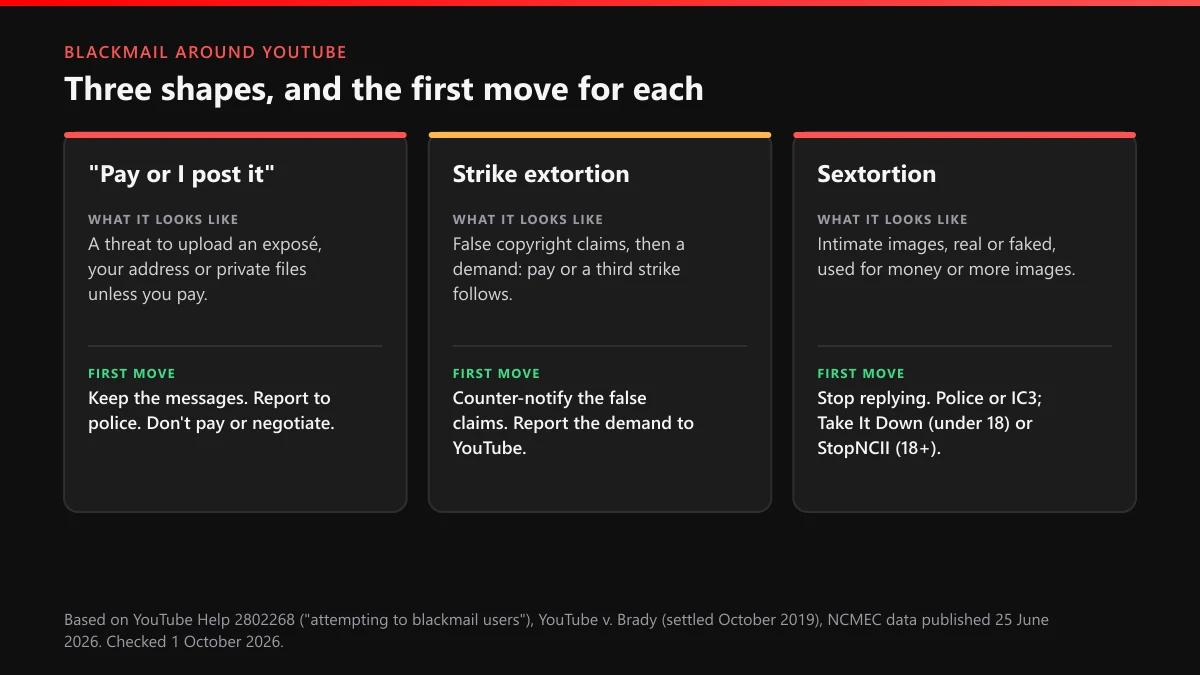
Don't pay, keep everything, and go to the police before you press Report. YouTube's harassment policy lists "attempting to blackmail users" next to stalking, and the same page tells people facing specific threats to "report it directly to your local law enforcement agency." Blackmail on YouTube usually takes one of three shapes. The first is "pay or I post": a threat to upload an exposé, your address or private files unless you pay, which also falls under the doxxing ban because threatening to share counts. The second is strike extortion. In 2019 YouTube sued Christopher Brady, who filed false copyright claims against two Minecraft creators and then demanded payment or "we will file a third strike"; he settled in October 2019 for $25,000 and an apology, as Tubefilter reported. The third is sextortion, which NCMEC says reached more than 50,000 financially motivated reports in 2025, an average of 137 a day.
Where does a YouTube blackmail report go first?
To police, with the evidence, and only then to YouTube. Screenshot the messages with usernames, dates and URLs before anything is deleted. In the US, the FBI takes extortion reports through IC3. If intimate images are involved, NCMEC's Take It Down service covers images taken before you turned 18, and StopNCII covers adults; both work from a hash made on your own device. After that, a YouTube blackmail report goes on the message, comment or video where the threat appears. Strike extortion has its own tools: knowing how a copyright strike works tells you when a counter-notification will clear a false claim. If the blackmailer re-uploads your own footage, a copyright removal request is yours to file, and a stolen-video takedown covers copies spread over several channels. Threats that arrive as a fake "YouTube copyright team" email or a sponsored ad belong with scam ads and fraud uploads.
When is it worth handing the case to someone else?
Everything on this page is free to file yourself, and for one abusive comment or one video you should. The calculation changes when a campaign spans a dozen uploads, three channels and a comment section that refills overnight. That is the work our content removal service does: we build the timestamped log, pick the right track for each item, and file through YouTube's own forms, so the reviewer sees a pattern rather than scattered flags. We don't file false or exaggerated reports, we can't promise any outcome YouTube controls, and we aren't a law firm, so defamation suits go to a lawyer. If you want to see what it realistically takes, read what it takes to get someone banned from YouTube, browse every YouTube reporting guide we keep, or start at the YouTube Ban Service home page. When you're ready, send the links through our contact page and we'll tell you which of the five routes applies before anything is filed.
FAQ
Does the YouTube harassment and cyberbullying policy cover comments and live chat?
Yes. The policy applies to videos, descriptions, comments, live streams and any other YouTube feature, plus external links in the content. A comment that doxxes someone or a live chat message that threatens them is judged by the same rules as a video, and you report it from the More menu next to it.
Will the person I report find out it was me?
Not from a Community Guidelines report. YouTube says reporting is anonymous and other users can't tell who made it. Legal complaints work differently: the uploader is notified of a defamation complaint, though you can ask YouTube to withhold your legal name and email, and the privacy complaint process says your name and contact details aren't shared with the uploader.
Can I report harassment on YouTube without an account?
Not with the Report button. Signed out, YouTube asks you to sign in before you can report content. The privacy complaint form opens without signing in, so someone who doesn't use YouTube can still file it about a video that shows them or their details.
How long does YouTube take to review a harassment report?
YouTube doesn't publish a review time. It says flagged content is reviewed around the clock and isn't removed automatically just because it was reported. You can check a video report's status at youtube.com/reporthistory on a computer; comment and channel reports don't show up there.
Can YouTube tell me who runs an anonymous channel that's harassing me?
Not on request. Google hands over account details only in response to valid legal process, such as a subpoena or court order, so unmasking a channel usually means filing a lawsuit and asking the court for that subpoena. Police investigating threats or blackmail can request the same data through their own channels.
Does a privacy or defamation removal give the uploader a strike?
Usually not. YouTube's strikes page says a removal after a first-party privacy complaint or a court order doesn't strike the channel, and the sample EU defamation email we read said no strike was applied. Strikes come from Community Guidelines decisions, which is why the harassment flag still matters when it fits.
Can I report a YouTube video for defamation with the normal Report button?
Only partly. The Report menu has a legal issue option that opens YouTube's legal webform, but a Community Guidelines flag on its own won't remove a video for being false. Choose harassment if the video also insults, threatens or doxxes you, and use the defamation complaint for the false statements themselves.
What if someone accuses my channel of harassment for criticising them?
Criticism of what someone did, said or sold isn't harassment under YouTube's policy, and debate about people in positions of power is an explicit exception. If a strike lands anyway, appeal it from YouTube Studio and point to that exception. Repeated insults about the person's intrinsic traits are where criticism stops being protected.