23 September 2026 · YouTube Ban Service · ~15 min read
Buy YouTube ban service? What bots and panels deliver
Don't buy a YouTube ban service that sells report volume. YouTube runs one flag and a thousand flags through the same review, filters abnormal flagging out, and removes a channel only for a confirmed rule break. Bots and panels cost you money, logins or your own Google account; an evidence-based report through an official route is what gets a channel struck.
What are you paying for when you buy a YouTube ban service?
Usually one of three products, sold under names that blur together: a downloadable "youtube mass report tool", a line item on an SMM panel, or a person in a Telegram chat who promises to do it for you. Search listings mix them freely, so a page titled "youtube ban service & video removal" can turn out to be any of the three, and a "youtube channel ban service" or "youtube channel removal service" ad rarely says which one it is. They differ in what you hand over and in where the risk lands.
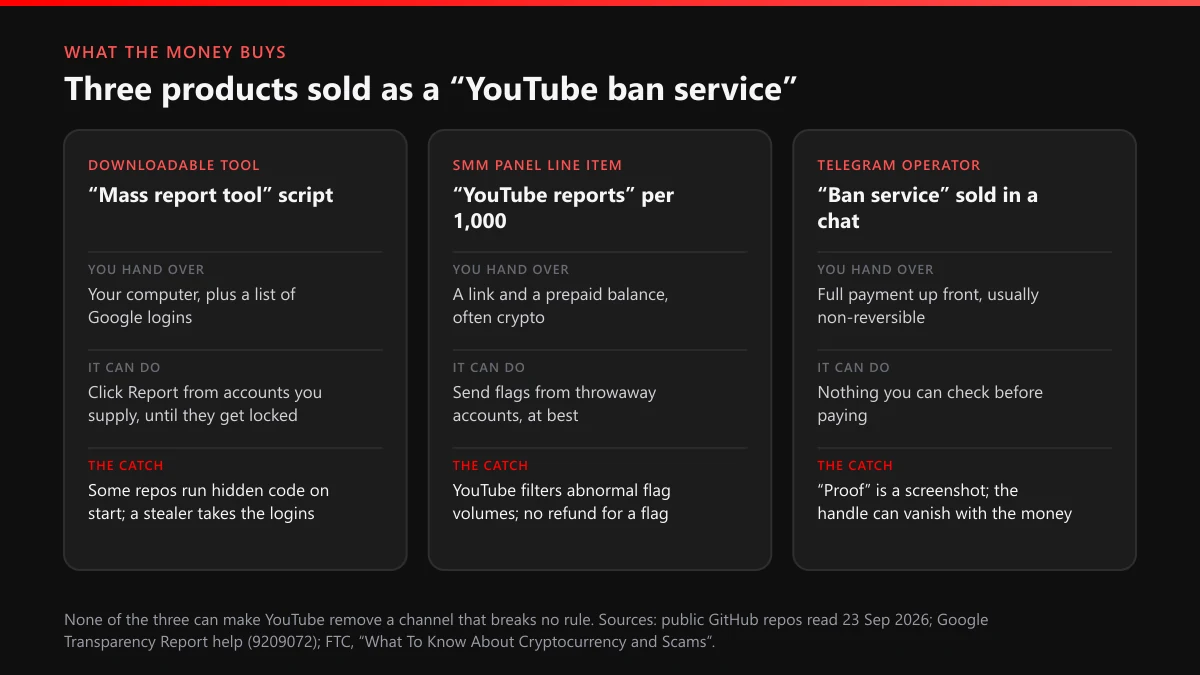
| Product | What you give | What it can physically do | What usually goes wrong |
|---|---|---|---|
| Script or app ("youtube mass reporter", "youtube spam report bot") | Your computer and a stack of Google logins | Press Report from each account you feed it | Accounts get locked; some scripts run hidden code that steals the logins |
| SMM panel "reports" package | A link and a prepaid balance, often crypto | Fire flags from throwaway accounts | Abnormal volumes are filtered; there is nothing to refund when nothing happens |
| Telegram "youtube mass report service" | Full payment up front | Nothing you can check before paying | A screenshot as proof, then silence |
| Evidence-based takedown help | The link, the harm and your proof | File the report, privacy, legal or copyright route that fits | May refuse the job if no rule is broken |
Only the last row maps onto anything YouTube actually acts on. The other three sell a count, and a count is the one thing YouTube's review ignores.
Can a YouTube channel get banned for mass reporting?
Not for the reporting itself. A YouTube channel can get banned from mass reporting only in the sense that one of the flags pointed a reviewer at a real violation, which a single accurate report would have done just as well. YouTube's reporting help is blunt about the other case: if reviewers find no violation, "no amount of reporting will change that, and the video will remain on our site."
The channels that do disappear are mostly the kind a ban seller would never be hired to target. From April to June 2026 YouTube removed 2,732,395 channels, and 2,310,181 of them, about 84.5%, went for spam, deceptive practices and scams, according to the Community Guidelines enforcement report. Removal follows strikes: three Community Guidelines strikes inside 90 days, one case of severe abuse, or three copyright strikes. The strike ladder and what "terminated" means on the channel page are laid out in our guide to a terminated or deleted YouTube channel.
Why so many people believe mass reporting works
Late 2025 gave the myth fuel. On 7 November 2025 Dexerto covered a wave of sudden terminations; the creator Enderman said YouTube had "wrongfully concluded my channel was associated with a channel that was terminated for three copyright strikes," and the channel was back within 24 hours. Nothing in the coverage tied the wave to reporting. The notices cited spam and deceptive practices, and by 9 December YouTube was telling Search Engine Journal that the "vast majority" of terminations hold on appeal while "a handful" had been wrong. Sellers still screenshot those episodes as proof their panel works.
Inside a mass report YouTube channel bot panel: two repos, read line by line
Most "free" tools are public code, so you can check what they do before running anything. On 23 September we took two of the repositories that surface for "mass report youtube channel bot" searches and read the source rather than the README.
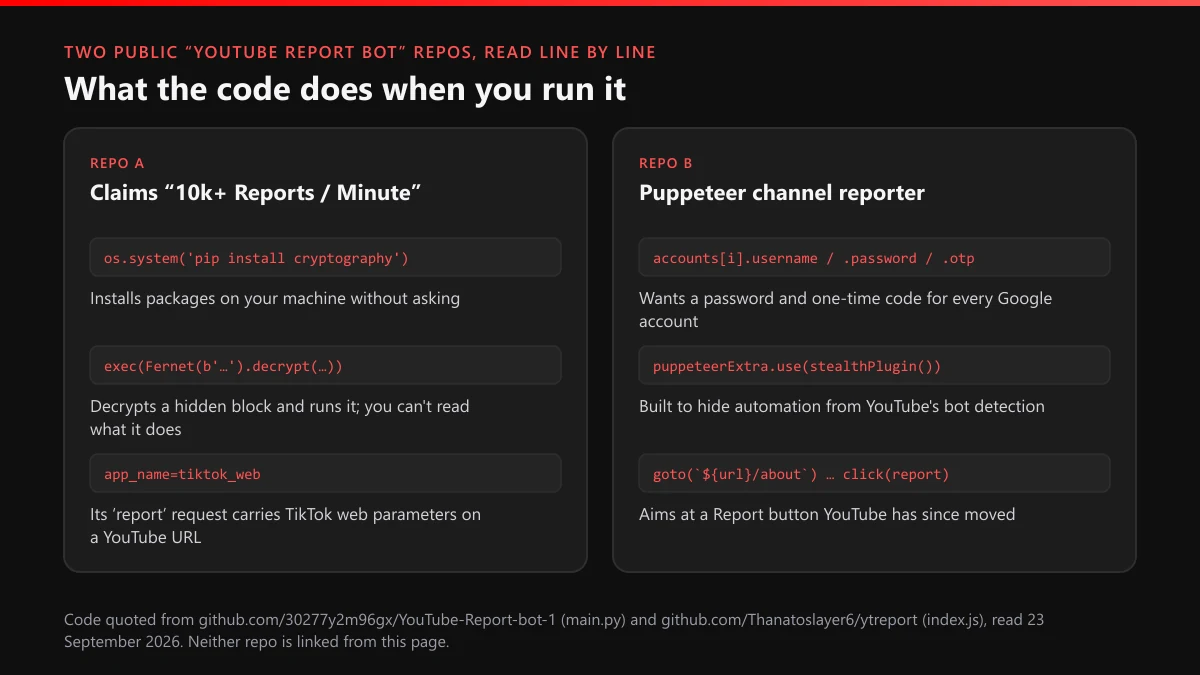
The first advertises "10k+ Reports / Minute." Its main.py installs three packages through os.system, then calls exec(Fernet(...).decrypt(...)): it decrypts a block you cannot read and executes it with your permissions. We did not run it, and we can't say for certain what the hidden block contains, but that pattern is how stealers get delivered. Oddly, the visible "report" request is copied from TikTok, with app_name=tiktok_web and a field called tiktokvideolink sent to a youtube.com address. It isn't a working YouTube reporter.
A youtube mass report tool that wants every password
The second is more honest about what it needs. It reads an accounts list where every entry holds a Gmail address, a password and a one-time code, logs into each one, loads the channel's About tab and clicks the report button. It also loads puppeteer-extra-plugin-stealth, whose whole job is hiding automation from detection. Two problems follow. It is written for a button YouTube has since moved; on a computer, Report user now sits behind "…more" in the channel description. And the "bot panel" is only as big as the pile of real Google accounts you give it, each of which is breaking YouTube's Terms the moment the script runs.
Fake-repo campaigns are common enough to assume the worst. Trend Micro reported on 5 March 2026 that more than 100 public GitHub repositories posing as game cheats and utilities were pushing BoryptGrab, a stealer that takes browser data, crypto wallets, Discord tokens and passwords.
Does mass reporting work on YouTube once the flags land?
No, because YouTube decided years ago not to count. "If a video gets one flag, or one thousand flags, it still goes through the same review process," YouTube Creator Liaison Matt Koval said, as quoted by Search Engine Journal on 25 May 2021. Five years on, the mechanics still point the same way.
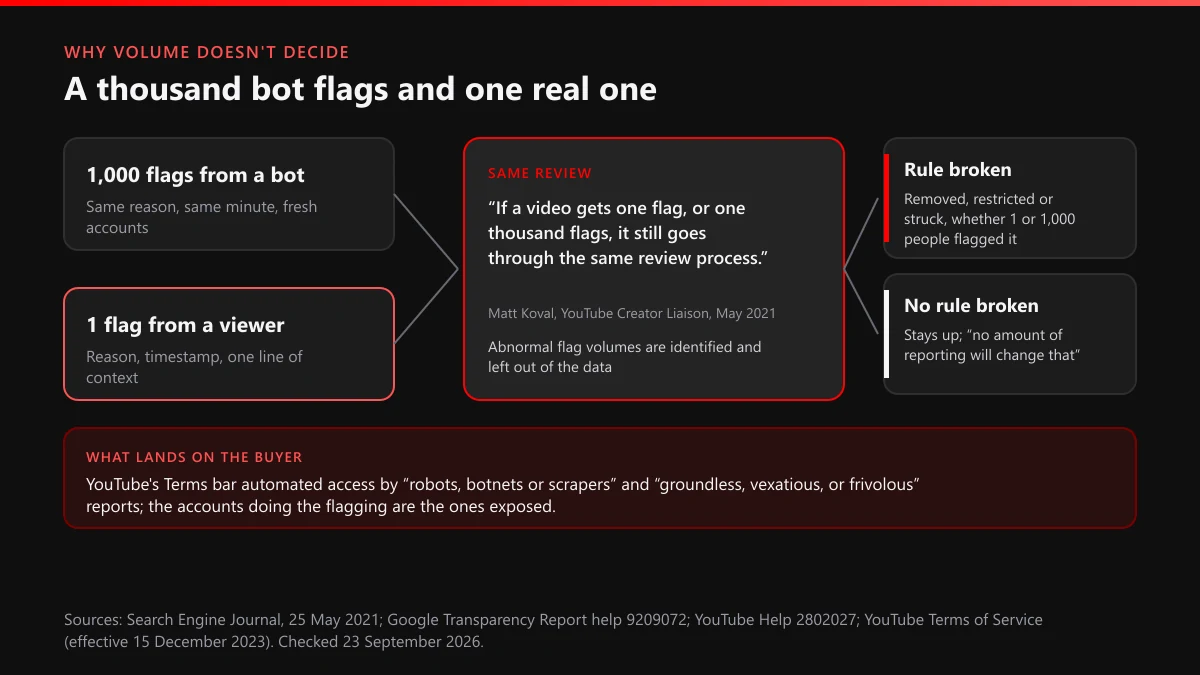
- Volume is screened out. Google's transparency help says systems identify "suspicious or exceptionally high flagging volumes" and drop them from the published data.
- The reason you pick doesn't limit the review. Reviewers check the video against every Community Guideline, so flooding one category adds nothing.
- Duplicates collapse. When a video already has many flags, YouTube reviews it "based on those flags," and your Reporting History keeps only your latest report on each video.
- Every flag needs a signed-in account. Signed out, the Report option only asks you to sign in, which is why every bot needs a supply of Google accounts.
What changes the outcome is precision. YouTube's Priority Flaggers get faster review because their flags have a higher action rate, not because there are more of them. So does mass reporting youtube videos ever help? Only when each report is accurate on its own, and then the "mass" part did none of the work. How reviews play out after the click, and who learns what, is covered in what happens when you report a YouTube video.
Who ends up banned: the target, or the accounts doing the reporting?
More often the second. YouTube's Terms of Service, effective 15 December 2023, forbid accessing the service "using any automated means (such as robots, botnets or scrapers)" and forbid misusing "any reporting, flagging, complaint, dispute, or appeals process, including by making groundless, vexatious, or frivolous submissions." A script that logs into 50 Gmail accounts and flags one channel from each is both at once.
The penalty lands on a Google Account, not just a YouTube profile. When Google disables an account for Terms violations, Gmail, Drive and Photos go with it, which is a lot to stake on a stranger's channel. The same Help page warns that "abuse of our legal forms may result in the termination of your Google Account." That covers the copyright webform too: a knowingly false takedown puts a sworn statement on record, and under US law a sender who materially misrepresents infringement can owe the uploader damages. Our pages on the YouTube copyright removal request and on how a copyright strike is filed spell out what you sign.
Sellers know this, which is why none of them uses their own accounts. They use yours, or ones bought in bulk that YouTube purges in waves. This is also the lesson we drew from the Instagram side of the same trade, set out in who really gets banned by an Instagram mass report tool and in our look at whether an Instagram spam report bot removes anything.
Seven checks before paying any YouTube takedown service
If you are still weighing a seller, run the offer through these before any money moves. A legitimate YouTube channel takedown service passes all seven without effort.
- Does it name the rule? Ask which Community Guideline, law or copyright the target breaks. "Our reports always work" is not an answer.
- Does it sell a number? "1,000 reports", "10k per minute" or a daily cap per channel means it sells volume, the thing YouTube filters out.
- Does it guarantee a ban or a deadline? Nobody outside YouTube can. A 24-hour guarantee is a sales line.
- How do you pay? The FTC puts it flatly: "Only scammers demand payment in cryptocurrency," and crypto payments "typically are not reversible."
- What is the proof? A screenshot of a "channel doesn't exist" page proves nothing; creators delete and rename channels every day.
- Does it ask for your logins? No genuine service needs your Google password, and certainly not your 2-Step codes.
- Will it turn you down? Ask about a channel that breaks no rule. A seller that takes that job will take any job, including one against you.
The losses behind that list are not small. The FTC told Congress on 25 March 2026 that consumers filed 3 million fraud reports in 2025 and reported $15.9 billion in losses, up from 2.6 million reports and over $12 billion a year earlier.
What does a legitimate YouTube video removal service do instead?
It chooses the route before it touches a form, because each problem has one route that can end in removal. A scam ad goes through the ad report and Google's advertiser policies; our scam ad and scam channel guide covers both. A stolen upload goes through copyright, where a valid notice strikes the channel directly, as set out in the stolen-video takedown walkthrough. A hijacked channel, a deepfake or a defamatory video each has its own form, listed in reporting hijacking, defamation and deepfakes. Fake products and false health claims sit under counterfeit and misinformation reports.
Then comes the file a reviewer reads in two minutes: the exact video and timestamp, the policy quoted, and, for impersonation, the original channel next to the copy. Reuploads and abusive comments go one by one, the way reporting a reupload or comment describes, because each notice covers only the links it names. A YouTube video removal service or youtube takedown service that works like this can't promise a date. It can promise that every filing is one YouTube is able to act on.
The refusals matter as much as the filings. A channel that copied someone's format, argues with them in videos or simply outgrew them breaks no rule, and a service that files anyway is spending your money on a review that ends in "no violation." When we read requests, the first question is always which sentence of which policy the channel breaks; if nobody can quote it, there is nothing to file. For the channels that do break one, the contact page is where a case starts.
How to mass report a YouTube channel when many people really were harmed
Sometimes a crowd has a real grievance: a scam channel that took money from a whole community, or a creator targeting one person with harassment. If you want to know how to mass report a YouTube channel in that situation, the version that counts is many accurate reports, not many copies of one. People typing "how to mass report youtube channell" into search usually want the same thing as everyone else: the channel gone.
- Each person reports from their own signed-in account, only for what they saw themselves.
- Report the specific video, Short or comment, with the timestamp where the violation starts. Use the steps in how to report a YouTube video, Short or comment.
- Report the channel itself only for channel-wide problems such as impersonation or a channel built for spam: "…more" in the description, then Report user. A channel report reviews the channel's own details, so check what a YouTube channel report actually checks before choosing it over a video report.
- Anyone whose own content, face or private details appear should use the copyright, privacy or legal route instead of a flag; those carry more weight than any flag.
- Victims of fraud should also report to the police or their national fraud agency, and keep payment records.
That is also the honest answer to "mass report youtube video" searches. Twenty people with twenty different timestamps give a reviewer twenty chances to see the problem, while two thousand bot flags give them nothing to look at. For a single video, the routes are compared in how to get a YouTube video taken down. If the problem is one commenter on your own channel rather than a whole channel, you don't need YouTube at all: hide the user from your channel and they vanish from your comments within seconds.
FAQ
Is it illegal to buy a YouTube mass report service?
In most countries buying one is not a crime in itself, but it breaks YouTube's Terms of Service, which bar automated access and groundless or vexatious reports. False copyright or legal complaints are different: a knowingly false DMCA notice can make the sender liable for damages in the US.
How many reports does it take to ban a YouTube channel?
There is no number. A YouTube Creator Liaison put it this way in 2021: one flag or one thousand flags go through the same review. A channel is removed after three Community Guidelines strikes in 90 days, one severe violation, or three copyright strikes, whoever reported it.
Can I get my money back from a YouTube ban seller?
Rarely. Most sellers take crypto, and the FTC notes that cryptocurrency payments typically are not reversible. A card or PayPal payment can be disputed with the provider; report the seller to the FTC or your national fraud agency either way.
Someone says they will mass report my channel. Should I worry?
Not about the volume. Flags alone do not strike a channel. Check that your uploads follow the Community Guidelines and turn on 2-Step Verification. If a strike does land, appeal it from YouTube Studio; a different reviewer decides, and wrongly removed videos are reinstated.
Do YouTube report bots on GitHub contain malware?
Some do. One public repo we read decrypts a hidden block of code and executes it when you run the script, which is a standard way to smuggle in a stealer. Security firms have documented large fake-repo campaigns, including more than 100 BoryptGrab repos reported by Trend Micro in March 2026.
What does a legitimate YouTube video removal service charge for?
For the work a reviewer needs: finding the policy or law the content breaks, gathering timestamps and links, and filing through the matching YouTube route. It cannot sell a guaranteed ban, and it should turn down channels that break no rule.
Does YouTube tell a channel it was mass reported?
No. The creator is told only when a video is removed or restricted, and the notice names the policy, not the people who flagged it. A burst of flags with no violation behind it leaves no trace on the channel.