26 May 2026 · YouTube Ban Service · ~10 min read
How to get someone banned from YouTube: match the violation to the route that removes it
To get someone banned from YouTube, you hand the platform a confirmable violation through the right official channel, and YouTube runs several. Match what the channel actually did — doxxing, impersonation, a stolen re-upload, harassment, a scam — to its matching report or webform. A reviewer then decides, and your report count never does.
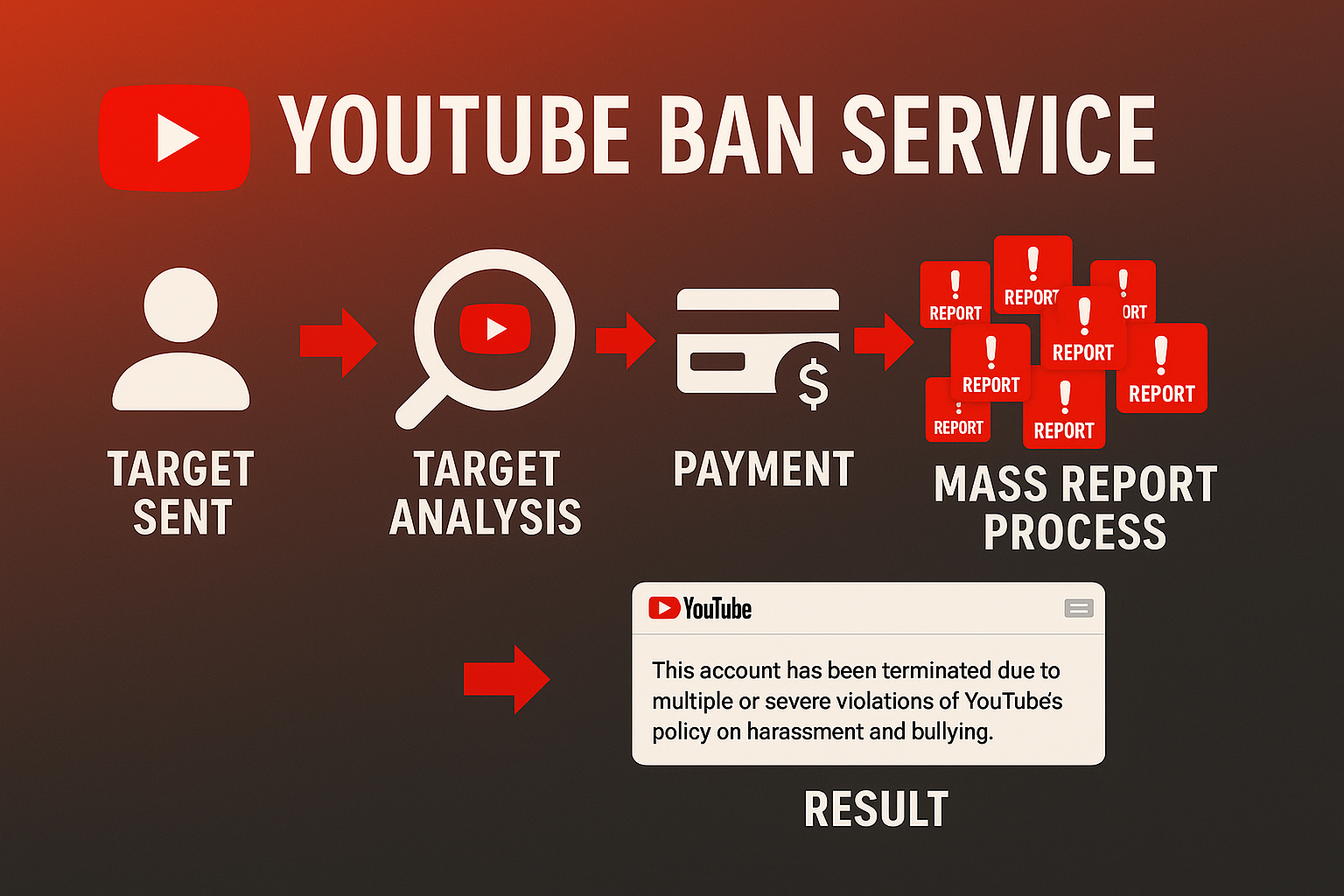
What does it actually take to get someone banned from YouTube?
It takes two things: a real breach of YouTube's rules, and the specific official channel built to act on that breach. There is no master ban button you can press, and searching how to get someone banned from YouTube turns up a lot of advice that quietly answers a different question — how to block or hide a viewer on your own channel. Those are not the same thing. Blocking someone, as YouTube's own block-a-channel guide spells out, only hides them from your videos and comments; they keep their account and carry on everywhere else. Getting a channel removed is YouTube's call, made when a reviewer or an automated system confirms a named violation. So the useful version of the question is narrower than it looks: what did this channel do, and which of YouTube's separate channels exists to handle exactly that?
Which YouTube report or webform removes which problem?
The right tool depends entirely on the violation, because YouTube splits removals across separate systems that barely talk to each other. A harassment flag, a copyright notice, and a privacy complaint land in different queues, run by different teams under different rules. Pick the wrong door and a sound case can sit for weeks. The table maps the situations people most often want handled to the official route built for each, and to who YouTube expects to file it.
| What the channel is doing | The route that removes it | Who YouTube expects to file |
|---|---|---|
| Posting your address, ID, phone or other personal details | Privacy complaint process | You, or your legal representative |
| Spreading provably false claims, or you hold a court order | Legal / defamation webform | The affected party, with specifics |
| Copying your name, handle, photo or logo to pose as you | Impersonation report | The impersonated person or brand |
| Re-uploading your original video without permission | Copyright removal webform | The copyright owner |
| Threatening, stalking or abusing someone on camera or in comments | Harassment & cyberbullying report | Anyone who sees it |
| A terminated channel back under a new name | Ban-evasion report | Anyone who recognises it |
Two of these sit outside the ordinary flag-and-report flow: the privacy complaint process and YouTube's legal removal webforms. That is precisely why most "get someone banned" guides never mention them, and why they are often the route that finally works after the in-video Report button keeps closing your case with nothing.
How do you get someone's YouTube channel banned for harassment or doxxing?
Report it under the harassment and cyberbullying policy, and when private information is exposed, add a separate privacy complaint on top. This is the situation behind most searches for how to get someone's YouTube channel banned, and YouTube treats targeted abuse seriously: its harassment and cyberbullying policy covers credible threats, prolonged insults, stalking, doxxing and swatting, and it applies to comments and live streams, not only uploaded videos. Doxxing has its own door. When a clip or comment reveals details that identify you — your home address, workplace, ID or bank number — the privacy complaint process lets you request removal directly, and YouTube weighs whether you are uniquely identifiable and whether the upload is genuinely newsworthy. Anyone typing how to get someones youtube channel banned after being targeted usually needs both routes running at once: the harassment report for the conduct, the privacy claim for the exposed data. If there is a credible threat to your safety, call local police in parallel, because a platform takedown is not an emergency service.
How do you remove a channel that's impersonating you?
File an impersonation report, and file it as the person being impersonated, because that is whose complaint YouTube acts on. A channel lifting your name, handle, avatar or branding to pass itself off as you breaks YouTube's impersonation policy, which explicitly invites the impersonated creator to report the copycat; a random bystander's flag carries far less weight in this category. Gather the proof first: your real channel, the fake one side by side, and any message where the impostor traded on your identity. If the impersonator also grabbed your @handle, that is a related but distinct fight, and our guide to claiming your YouTube username covers the handle and trademark side of it. Impersonation is one of the categories YouTube can act on quickly, since a clone is easy for a reviewer to confirm against the genuine account.
How do you get a channel banned for stealing your videos?
Send a copyright removal request through YouTube's webform — not Content ID — when a channel re-uploads your original work. The removal request is a manual copyright notice that any rights holder can submit, naming the infringing upload and the original you own, and it carries an option to block future re-uploads of the same file so the thief cannot simply post it again. A valid notice places a copyright strike on the offending channel, and three of those inside 90 days end it. Content ID is a different animal: an automated matching system reserved for large rights holders with a catalogue, not something an individual creator files case by case. Confusing the two is why people wait on a "match" that never arrives. File the webform yourself, or let our official reporting solutions confirm you hold the rights and map the copyright path before anything goes out, since a knowingly false claim is itself a violation.
Will the person know it was you, and what will you actually see?
No, and you will not get a play-by-play either. YouTube keeps reports confidential, so the channel you flag is never told who reported it; the retaliation people dread when they ask whether the target will find out simply is not part of the system. You also will not get a detailed verdict. Unlike an appeal, a report rarely comes back with a status update, and if YouTube reviews the content and finds no breach, nothing happens and you hear nothing back. Read the silence as the decision: a reviewer looked, and the content stays. It is not a hint to refile from five more accounts. Reporting the same rule-abiding channel over and over drifts into the misuse YouTube actively watches for, and it changes none of the outcome. One precise report from one account does everything a thousand from a bot cannot.
What happens to the channel after a valid report?
If the report sticks, the channel moves along YouTube's strike system rather than vanishing on the spot. A first confirmed breach usually brings a one-time warning; after that, three Community Guidelines strikes inside a 90-day window end the channel for good, and copyright runs its own separate three-strike count. The gravest cases, such as credible threats or child safety, skip the ladder and terminate at once. I will not re-document every rung here; our breakdown of what actually strikes a channel walks through the full ladder. The scale is worth one number, though: across 2019 to 2024 YouTube removed well over 100 million channels, the overwhelming majority caught by its automated systems rather than flagged by viewers, per YouTube's Community Guidelines enforcement Transparency Report. Your report is not there to pad a tally; its job is to point a reviewer at the one breach they can confirm.
What if the channel just comes back under a new name?
Report it as ban evasion, because a terminated channel is not allowed to return at all. YouTube's terms on termination are blunt: once a channel is removed, the person behind it may not use, own, or create another, and any circumvention channel they spin up is terminated as well once YouTube ties it back to the original. So if the scammer or impersonator you reported reappears under a near-identical name, you are not starting from zero — you flag the new channel and point to the one already removed. Since late 2025 YouTube has piloted a way to request a brand-new channel a year after termination, but that is a fresh start, not a restored channel, and copyright terminations are excluded. One caveat worth naming honestly: if a false report ever lands on you instead, the answer is an appeal, and our guide on how to recover a wrongly terminated channel covers that side.
The shortcuts that don't work, and how they backfire
None of the paid shortcuts work, and several put you at more risk than the channel you are targeting. Search how to get someone banned on YouTube and you will hit panels and Telegram services selling "guaranteed" bans, mass-report bots, and apps that claim to reveal who reported a channel. Every one of them trades on a lever YouTube does not pull — report volume — so against a rule-abiding channel they accomplish nothing. The "see who reported you" tools are straight phishing, built to harvest the Google login that controls your Gmail and Drive, not just your channel. And organising a pile-on breaks the rules by itself: coordinated false reporting is the sort of manipulation that gets the organisers actioned, not the target. We take the bot myth apart in full in why a mass report bot can't strike a channel. The honest route is the unglamorous one this page lays out: name the real violation, pick the matching official form, and let the review run its course.
Reporting a channel that genuinely breaks the rules is not just allowed; it is how YouTube is meant to work. What does not work is faking a crowd. When a case is real, our YouTube ban service qualifies it, chooses the privacy, impersonation, copyright or harassment route that fits, and files it through YouTube's own channels, and you can send us the channel to review. Legitimate channels are left alone.
Sources
- YouTube Help — Community Guidelines strike basics (warning, three strikes in 90 days, termination)
- YouTube Help — Block channels (blocking hides a viewer; it does not remove their account)
- YouTube Help — Privacy complaint process (uniquely identifiable information)
- YouTube Help — Other legal complaints and removal webforms
- YouTube Help — Impersonation policy (reported by the impersonated party)
- YouTube Help — Harassment & cyberbullying policy (covers comments and live streams)
- YouTube Help — Submit a copyright removal request (manual notice, distinct from Content ID)
- YouTube Help — Channel terminations and the ban-evasion rule
- Google — YouTube Community Guidelines enforcement Transparency Report
FAQ
How many reports does it take to get a YouTube channel banned?
No fixed number, because YouTube weighs whether a real violation exists, not how many reports arrive. A channel is terminated after three confirmed Community Guidelines strikes in 90 days, three copyright strikes, or one severe violation, and none of those can be manufactured by a pile of reports.
Will someone know if I report their YouTube channel?
No. YouTube keeps reports confidential and does not tell the channel who flagged it. Any site or app claiming to reveal who reported an account is a phishing scam, not a real YouTube feature, and it usually exists to harvest your login.
Can you get someone banned on YouTube for no reason?
No. With no genuine violation there is nothing for a reviewer to confirm, so the channel stays up however many reports it collects. Filing knowingly false reports, or organising others to pile on, can instead get your own account actioned for misuse.
How do I report a YouTube channel for doxxing or sharing my personal information?
Use YouTube's privacy complaint process, which is separate from a standard report. It lets you ask for removal of content that makes you uniquely identifiable, such as your address, ID, or contact details. Pair it with a harassment report when the same channel is also targeting you.
If I report someone's comment on YouTube, will they be notified?
No. Reporting a comment is anonymous and the commenter is not told who flagged it. Comments are reportable in their own right, not only videos and channels, so an abusive comment can be flagged from the three-dot menu beside it.