2 October 2026 · YouTube Ban Service · ~13 min read
YouTube copyright claim vs strike: why a claim is a policy and a strike is a penalty
A YouTube copyright claim is a rights holder's instruction attached to one video, usually placed automatically by Content ID: block it, run ads for the claimant, or just track views, and the choice can differ by country. It isn't a penalty. Strikes come only from a legal removal request, and three of them in 90 days can end a channel.
What does a copyright claim mean on YouTube when it shows up in Studio?
It means Content ID or a rights holder found someone else's material in your video, and that owner has already decided what happens to it. In YouTube Studio the video's Restrictions column reads "Copyright claim", and the claim details name the claimant, the claimed segment and the policy. YouTube's own summary fits in one line: claims "affect videos, but usually don't impact your channel or account," according to the help page What is a Content ID claim?
So what is a copyright claim on YouTube, stripped down? The YouTube copyright claim meaning fits in five words: an instruction attached to one upload. The email that announces it uses the same alarming word as a strike notice, which is why so many uploaders search for the difference with their stomach in a knot. Most of the time the knot can go. What a claim changes is where the money goes, or who can watch. It doesn't put the channel on a clock.
Which of the three claim policies is sitting on your video?
Check the policy before anything else, because it sets the real cost. YouTube's page on video restrictions names three: block the content from being viewed, monetize it by running ads and "sometimes sharing revenue with the uploader", or track its viewership statistics. Any of them can be geography-specific. One video can earn for the claimant in Germany, play untouched in Brazil and sit blocked in Japan.
| Policy | What viewers see | Where the ad money goes | What it means for you |
|---|---|---|---|
| Block | "Video unavailable" in the blocked countries, or everywhere | Nowhere, the video can't be watched there | The only policy that hides your work. A worldwide block looks like removal to a viewer, but carries no strike |
| Monetize | The video plays normally, with ads | To the claimant; Partner Program members may share revenue when the claim is for music | You lose that video's revenue unless you dispute or qualify for a share |
| Track | The video plays normally | Not what this policy is for: the owner is watching the numbers | Usually nothing to do, unless you think the match is wrong |
| Mixed by country | Depends on where the viewer is | Split by territory | Read the per-country list in the claim details, not just the headline policy |
Those three policies, plus the dispute and edit tools further down, are effectively the whole YouTube copyright claim policy as it applies to an uploader. Everything else on the topic belongs to strikes.
What is a Content ID claim on YouTube, and when is a claim manual instead?
A Content ID claim is the automatic kind. YouTube compares uploads against reference files that rights holders supplied, and when a match turns up, the owner's preset policy is applied without anyone watching your video. That is what people mean by a YouTube automatic copyright claim. Access is narrow: Content ID goes to owners with "exclusive rights to a substantial body of original material that is frequently uploaded", and YouTube lists compilations, gameplay, music licensed without exclusivity and recordings of performances as material it won't accept.
The scan starts before you publish. Studio's Checks step runs a Copyright check that "searches for copyrighted content in your video", and you can publish while it's still running and fix issues later. Clean results aren't permanent, though. YouTube's upload page warns that "future manual copyright claims, copyright strikes, and edits to your video settings may impact your video."
Manual claims run on stricter rules
Manual claims are placed by a person at a partner company using Content ID's tools, and YouTube grants that tool only to partners with "an advanced working knowledge of copyright and Content ID". Since a policy change YouTube announced on 15 August 2019, every manual claim must carry accurate timestamps. Unintentional use, like a song playing in a shop behind you, may not be claimed with a monetize policy, and a claim on a very short snippet may monetize only in "very limited circumstances". Automatic claims sit outside that rule, which is worth knowing when you read whose claim it is.
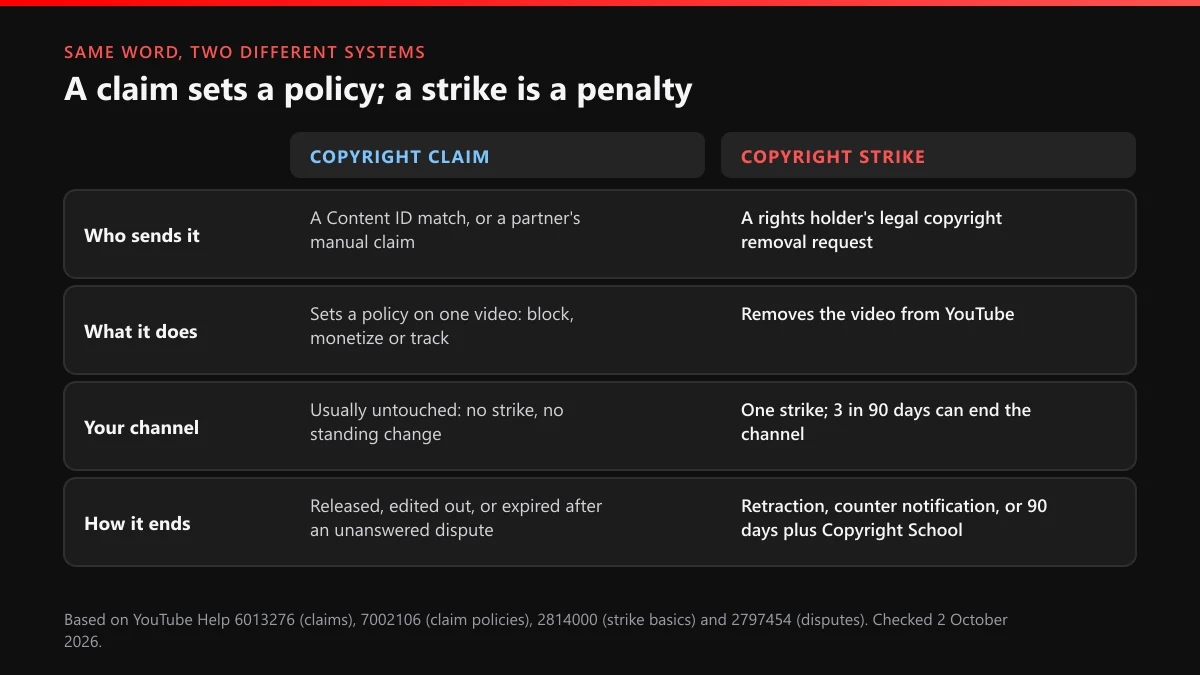
YouTube copyright claim vs strike: where does one turn into the other?
At exactly one point: a copyright removal request. Claims live inside Content ID. Strikes come from the legal side, where an owner asks YouTube to take a video down and signs a notice saying the use isn't authorised. YouTube says a Content ID claim "typically doesn't result in a copyright strike," and that word typically is carrying weight, because a claimant can step from one system into the other.
| Question | Copyright claim | Copyright strike |
|---|---|---|
| Who starts it | A Content ID match or a partner's manual claim | A copyright owner or their agent, through a removal request |
| What happens to the video | A policy is applied: blocked, monetized or tracked | It comes down |
| Channel standing | Usually unchanged | One strike; 3 strikes in 90 days and the channel is subject to termination |
| How it goes away | Release, an edit that removes the material, or an unanswered dispute or appeal | Retraction, a counter notification, or expiry after 90 days once Copyright School is done |
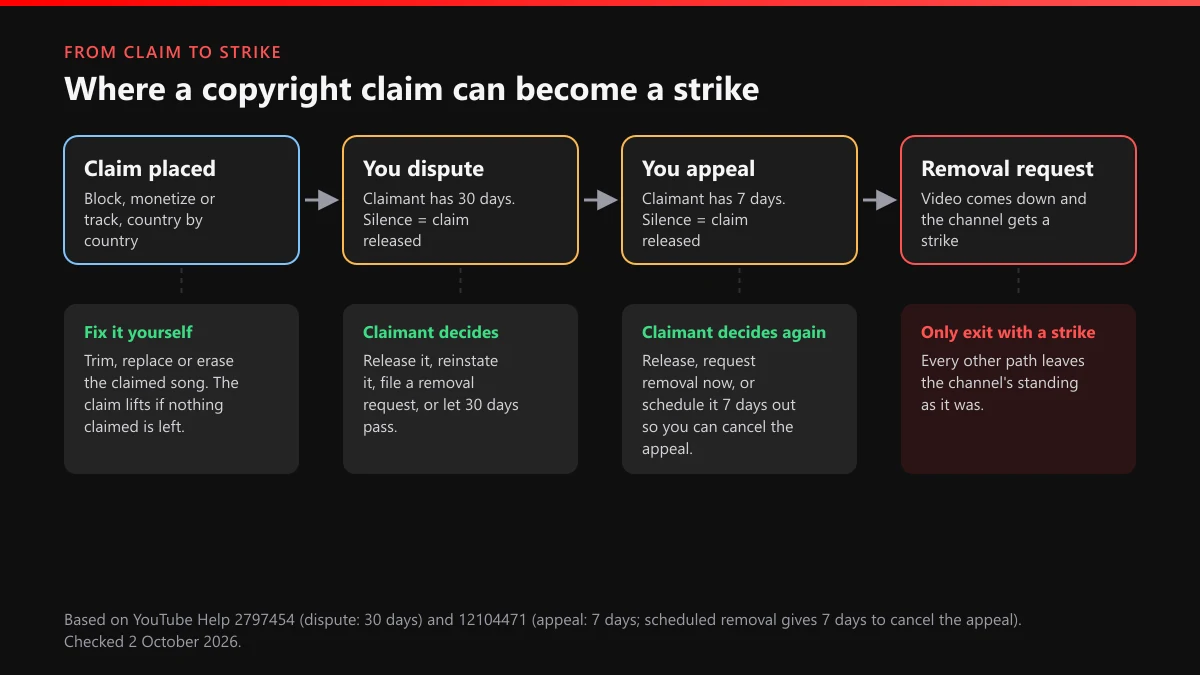
Three doors lead from claim to strike. The claimant rejects your dispute and files a removal request instead of simply reinstating the claim. Or the claimant answers your appeal with a removal request, either immediately or scheduled 7 days out. Or the owner never bothers with a claim and files against the video directly. The first two are why the dispute screen deserves care: a dispute you can't back up invites the one response that hurts. How strikes are counted and how long they last is covered in our guide to how a YouTube copyright strike is filed and counted, and the notice itself, including the scheduling choice, in the copyright removal request and its seven-day option.
How does YouTube copyright claim monetization work while you dispute?
When both sides want to monetize, the money waits instead of leaving. YouTube's rule on monetization during Content ID disputes reads: "If you dispute a copyright claim within 5 days, any revenue from the video will be held, starting with the first day the claim was placed." File on day six or later and the hold only starts from the date of the dispute. Once it's resolved, YouTube pays the held revenue to whoever wins.
Outside a dispute, a monetize claim sends the ad revenue to the claimant. Partner Program members get one carve-out: when the claimed material is music, YouTube says "you may be able to share revenue with the music publisher". No split is published for ordinary claims, so be wary of anyone quoting one. And when every claim on the video is released, your monetization settings come back automatically. Nothing needs switching on again.
Should you dispute, appeal or cut the claimed part out?
Work through it in this order, and stop at the first step that settles it.
- Read the segment and the policy. Track claims on a video you don't monetize cost you nothing. A monetize claim on a 40-second clip of someone else's song in a ten-minute vlog costs that video's ads.
- Edit if the claimed part isn't essential. Studio offers Trim out segment, Replace song from the Audio Library, and Erase song, which can mute only the song or "Mute all sound in the claimed segments". The editing help page lists the limits: an edit "might not work if the song is hard to remove", channels outside the Partner Program can't save edits on videos past 100,000 views, and since June 2025 a saved edit can't be reverted. If any claimed material is left, the claim stays.
- Dispute only with a reason you can show. Your own original work, a licence, public domain material or a fair use argument you'd stand behind. The claimant has 30 days to respond; if they don't, the claim expires and is released. Once sent, a dispute "can't be canceled", and YouTube's dispute page warns that "repeated or malicious abuse of the dispute process can result in penalties against your video or channel."
- Appeal only if the rejection is wrong and you'd defend it legally. The claimant then has 7 days. They can release the claim, request removal right away, or schedule the removal, which gives you 7 days to cancel the appeal before the video comes down and the strike lands. Some channels can escalate a block claim straight to appeal; the option shows on the channel features page.
- Answer a strike with a counter notification, not another dispute. Once a removal request has gone through, you're in the legal system, and the counter notification is the instrument for it.
Most uploaders stop at step two, and the numbers below suggest that's sensible. Disputes are rare, and they're a commitment.
How many copyright claims are allowed on YouTube?
YouTube doesn't set a number. When we went through YouTube's claim, dispute, strike and live-stream help pages on 2 October 2026, we saw a count only on the strike side, three in 90 days. None of the claim pages caps how many claims a channel or a single video can carry, so third-party guides that quote a limit are guessing.
What adds up is the effect per video, and the scale is enormous. Google's YouTube copyright transparency report for 2025, as TorrentFreak reported on 6 June 2026, counted 2,502,941,368 content ID claims YouTube processed that year. Uploaders disputed 12,840,608 of them, 0.51%, and 67.42% of those disputes were resolved in the uploader's favour, down from about 70% in 2024. By our arithmetic that's roughly 8.66 million disputes won by the person who uploaded the video.
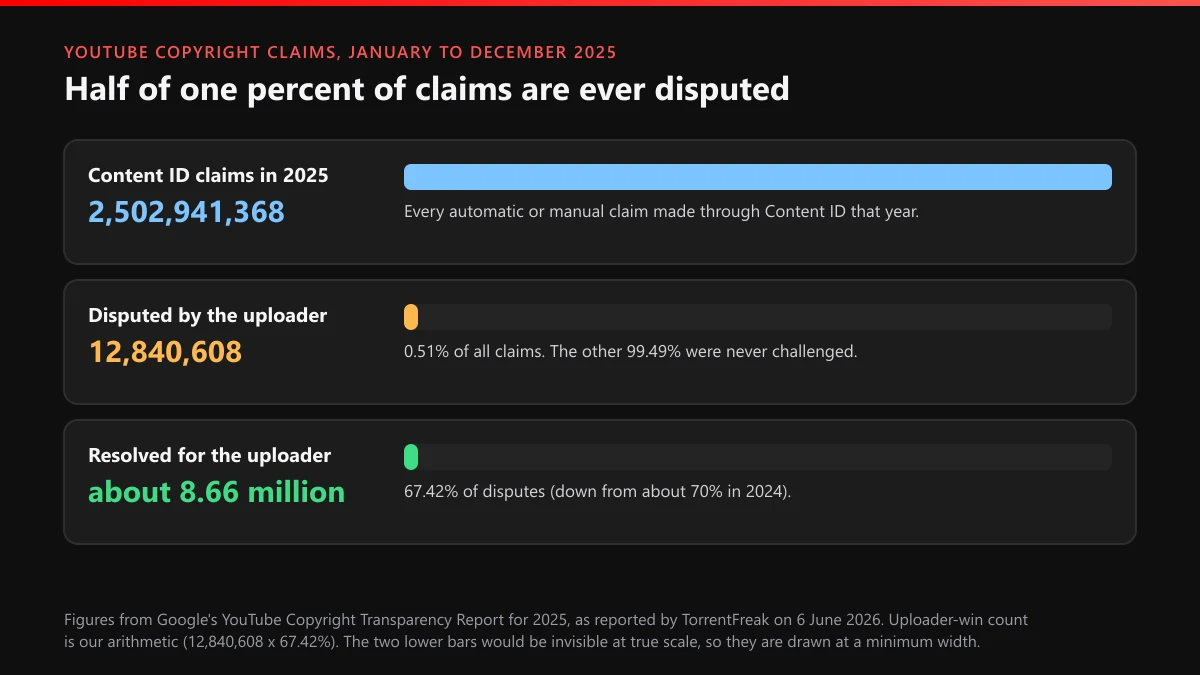
Read the two percentages together. Almost nobody disputes, yet disputes mostly succeed, which says something about how many claims are mismatches or overreach that uploaders simply accept. Live streams are where volume bites fastest. YouTube scans them as they run; a placeholder image may replace the stream with a warning, and carrying on can get it "temporarily interrupted or terminated". The claims themselves arrive only after the stream ends, and only if you archive it.
Does a copyright claim affect a YouTube channel at all?
Not its standing. Claims add no strike, count toward nothing and don't spread to your other videos. Two indirect costs are real, though. Build a catalogue on claimed music and the channel ends up earning mostly for other people. And a dispute habit built on bluffing can draw the penalties YouTube keeps for abuse of the dispute process.
If your channel actually was terminated, a claim wasn't the cause. Strikes or guideline violations were, and it helps to start by telling a terminated channel from a deleted one before working through the appeal and reinstatement routes for a banned channel. YouTube's own termination pilot, which lets some creators ask for a new channel after a year, excludes channels terminated for copyright infringement.
On the other side: should a copycat get a claim or a strike?
If you own the work and someone else reuploads it, the same choice looks different. Most owners don't have Content ID at all, so their only copyright tool is the removal request, which places a strike. Owners who do have Content ID face a real decision: a monetize claim leaves the copy up and collects its ads, while a removal request takes it down and moves the uploader one step closer to termination. Plenty of labels choose the money. A small creator whose copies are eating their views usually wants the copy gone.
For that side of the problem, start with stolen-video takedowns for the person who made the original. If one upload is the whole problem, getting a single YouTube video taken down is the narrower job; when a channel exists only to repost other people's work, a takedown of the whole copycat channel fits better. We've also written up what it takes to ban a channel that keeps breaking the rules and, for the blunter question, what actually gets another person banned from YouTube. Copycats often grab a look-alike handle too, and reclaiming a YouTube handle someone took runs on its own rules. If you'd rather hand the whole thing over, that's what a YouTube content removal service is for.
When the copy is also a scam, a fake or a hijack
Copyright isn't always the strongest route. A copy cut into a fake giveaway ad belongs with reporting YouTube ads and scams; a counterfeit product video or a doctored clip with counterfeit and misinformation reports; a channel taken from you, or one lying about you, with hijacking and defamation reports. Reuploads that also spam your comment section are covered in reporting reuploads and comment spam.
Can a report button or a bot put a claim on someone's video?
No. Claims come only from Content ID partners, and strikes only from copyright owners or their agents. A Community Guidelines flag goes to a reviewer who checks the rules, not ownership: what happens after you press Report and what a reviewer looks at in a channel report explain that queue, and reporting a single video under the Community Guidelines is the right tool when the problem is a rule break rather than a copy.
Sellers of a YouTube mass report bot or ban-service bots and report panels can't create either one. The same pitch circulates for Instagram as Instagram mass report tools and spam-report bots aimed at Instagram accounts, with the same result.
Fake copyright notices are worse than useless, because a removal request is a legal statement and a false one invites a counter notification and liability.
Our advice to anyone holding a claim notice is short. Read the policy, edit the claimed part out if you can, and dispute only what you'd defend in writing. Holding the original of a stolen video instead? Skip the claim system and file a removal request.
The full list of YouTube problems we handle sorts the rest by situation, the YouTube Ban Service home page explains how the service works, and our contact page is where to send the claim notice or the copycat links.
FAQ
Is a Content ID claim the same thing as a copyright claim?
Mostly, yes. Copyright claim is the umbrella term YouTube Studio shows, and claims come through Content ID, either from an automatic match or from a partner's manual claim. A copyright strike is the separate thing, created by a legal removal request rather than by Content ID.
Can a copyright claim turn into a strike without me doing anything?
Not on its own. Strikes need a copyright removal request. The claimant can file one after rejecting your dispute or appeal, and an owner can also file one directly against any video, claimed or not. Leaving a claim alone never adds a strike.
Do copyright claims on YouTube expire?
YouTube describes no expiry date for a claim you leave alone; it stays until the claimant releases it or you edit the claimed material out. Disputed claims are released if the claimant doesn't respond within 30 days, and appealed ones if the claimant doesn't respond within 7 days.
Can I still make money from a video that has a copyright claim?
It depends on the policy. Under a monetize claim the ads pay the claimant, though Partner Program members may share revenue with the music publisher when the claim is for music. If you dispute within 5 days and both sides want to monetize, revenue is held from the day of the claim and paid to whoever wins.
Can I withdraw a dispute after I send it?
No. YouTube says a dispute can't be canceled once it's submitted. Appeals differ: if the claimant schedules a removal request, you get 7 days to cancel the appeal before the video comes down and the strike lands.
Why did a claim appear after my upload passed the Checks step?
Checks only cover what was matched at that moment. YouTube warns that later manual claims, strikes and changes to your video settings can still affect the video, so a clean result at upload isn't permanent.
What happens if my live stream plays copyrighted music?
YouTube scans live streams as they run. The stream may be replaced by a placeholder image and you'll be warned to stop; if you carry on, the stream can be interrupted or terminated. Claims are only placed after the stream ends, and only if you archive it.
Can anyone place a copyright claim on my video?
No: claims come only from Content ID partners, who must hold exclusive rights to the material, and manual claiming is limited to partners with advanced copyright knowledge. If a claim targets your own original work or something you licensed, that's what the dispute form is for.
Is a copyright strike the same as a Community Guidelines strike?
No. Community Guidelines strikes are YouTube's own penalty for breaking its rules, and they run on a separate count from copyright strikes. Copyright claims belong to neither system: they set an owner's policy on one video and don't add to either count.