16 August 2026 · YouTube Ban Service · ~10 min read
What is a YouTube copyright strike, and who can actually file one?
A YouTube copyright strike is the penalty YouTube applies to a channel after it accepts a valid copyright removal request from the rights holder. You cannot file a strike directly. You file the removal request, and the strike follows if YouTube approves it. Three strikes in 90 days end the channel.
Almost everything written about this subject is written for the person who got struck. That leaves the other half of the table empty. If your video was stolen, your course was reuploaded, or your footage is running on a channel that never licensed it, you are the one who has to decide which instrument to use, and the wrong choice can leave the video up permanently while you wait for a system that was never going to remove it.
Copyright claim vs copyright strike: which one actually removes a video?
Only the strike removes it. That is the whole answer to copyright claim vs copyright strike, and it decides your entire approach. A Content ID claim is generated automatically when an upload matches a reference file, and the rights holder's chosen policy then monetises, tracks or blocks that video. A copyright strike is different in kind: it is the consequence of a legal removal request that a human filed and YouTube accepted. YouTube states plainly that Content ID claims "are different from copyright removal requests and copyright strikes."
The practical consequence catches out most first-time filers. If your goal is to have the video gone, a claim will never take you there, however many of them you accumulate. Claims are a revenue instrument. Strikes are a removal instrument. The third column below is the one no comparison article bothers with, and it is the confusion we spend most of our time unpicking with clients.
| Content ID claim | Copyright strike | Community Guidelines strike | |
|---|---|---|---|
| What triggers it | Automatic match against a reference file | A valid copyright removal request | A policy breach: scams, harassment, spam |
| Who starts it | The matching system, on the owner's behalf | The owner or an authorised representative | Anyone who reports, then YouTube review |
| What happens to the video | Stays up, unless the policy is "block" | Removed | Removed |
| Effect on the channel | Usually none | Strike on the channel | Strike on the channel |
| Counts toward termination | No | Yes — 3 in 90 days | Yes — 3 in 90 days, separate count |
| How it clears | Dispute, or the claimant releases it | Copyright School, retraction, or counter notification | Lapses at 90 days |
Both strike columns end in termination, and both use a 90-day window, but the counters never pool. A reuploaded scam video can carry one of each at the same time. When we map a case we sort every piece of evidence into the correct column first, which is also how our guide to the official takedown routes is organised.
What is a YouTube content id claim, and why does it never become a strike?
A youtube content id claim is an automated match, and on its own it carries no channel penalty at all. YouTube's own wording is that Content ID claims "affect videos, but usually don't impact your channel or account." The one escalation path is indirect: if an uploader disputes a claim without valid grounds, the rights holder may respond by filing a copyright removal request, and that request is what produces the strike. The claim never converts by itself.
The scale here explains why so many creators meet a claim long before they meet a strike. YouTube logged 2,502,941,368 Content ID claims during 2025, up 14% on the 2.2 billion recorded in 2024, and roughly 99% of all copyright actions on the platform run through that system rather than through manual notices, per YouTube's Copyright Transparency Report as reported by TorrentFreak in 2026. Access is narrow, though. Of the rights holders approved for Content ID as of December 2025, 7,626 held access and only 4,454 actually used it that year. Everyone else files by hand.
How to copyright strike a YouTube video that reuses your work
You do not strike it. Understanding that sentence is most of the work, so it is worth being blunt about the mechanics of how to copyright strike a youtube video: you submit a copyright removal request naming the work and the infringing URL, YouTube reviews it with a mix of automated systems and human reviewers, and if the request appears valid the video comes down and a strike attaches to that channel. The strike is an outcome, never an input. Everything you control happens before you press submit.
Standing is the gate, and it is checked. YouTube's own instruction is that "copyright owners should submit copyright removal requests. Alternatively, an authorized representative, such as an attorney, can submit on behalf of a copyright owner." There is no route here for someone who simply wants a channel gone. If you do not own the work or act for the person who does, this instrument is closed to you, and the rest of this page will not help you open it.
"How to give copyright strike on youtube" — what that search is really asking
Two very different people type how to give copyright strike on youtube into a search box. One owns a film, a track or a course that somebody lifted wholesale. The other wants leverage over a channel they dislike. YouTube's copyright form addresses the second directly: "Do not submit false information. Misuse of our processes, such as submitting fraudulent documentation, may result in the termination of your account or other legal consequences."
That warning is not decorative. Filing also costs you your anonymity, which surprises people. The uploader receives the name of the purported copyright owner, your full legal name and your primary email address as part of the notice. A copyright complaint is a signed legal assertion, attached to a real identity, aimed at a stranger who can answer it.
How to file a copyright strike on YouTube: what a valid request must contain
Knowing how to file a copyright strike on youtube means knowing what survives review, because an incomplete notice is simply returned and nothing moves. A request that holds up carries five things:
- Your signature, physical or electronic, as the owner or the agent acting for them.
- Identification of the copyrighted work you own: the original, not a description of the theft.
- The specific URL of the infringing video, precise enough that a reviewer can open it.
- Your real contact details, including a legal name and a working email address.
- A good-faith statement that the use was not authorised by you, your agent or the law.
- A statement made under penalty of perjury that your information is accurate and you are authorised to act.
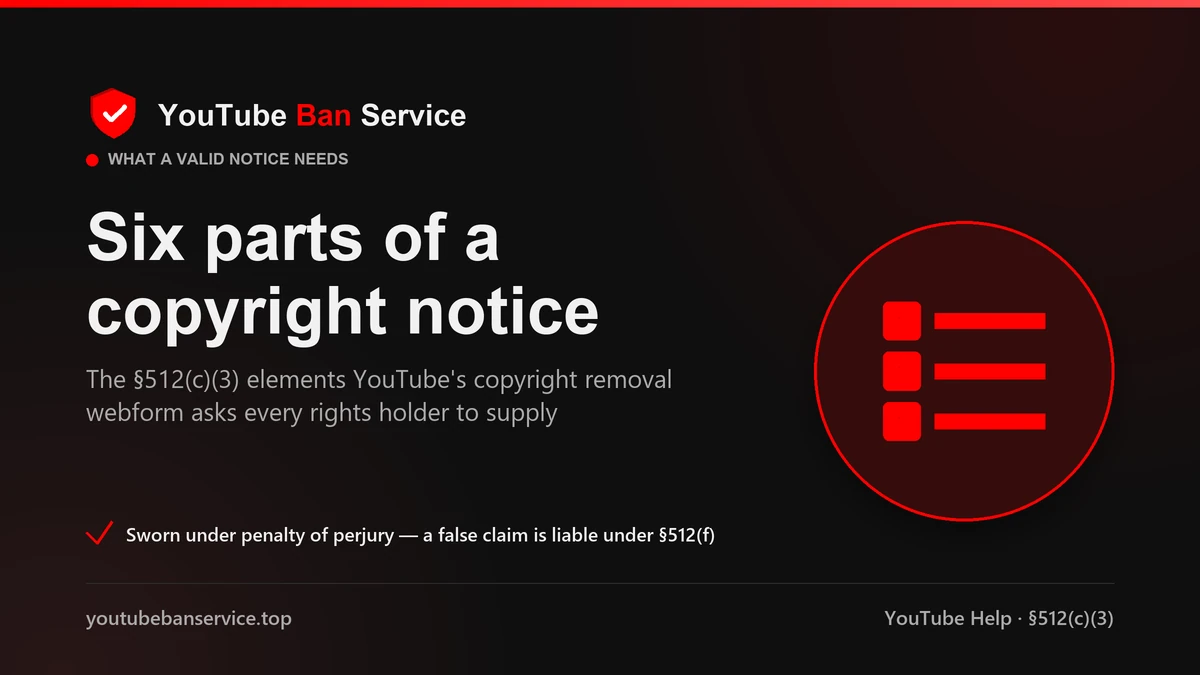
Those elements come from 17 U.S.C. §512, enacted on 28 October 1998, which is what makes notice-and-takedown mandatory for platforms rather than optional. The field-by-field walk through the webform, the signature statements and the seven-day scheduling option all belong to the removal request itself, which we treat as a separate subject; our page on getting a specific video taken down covers the other removal surfaces.
What matters at this stage is evidence. We ask every client for proof of ownership before looking at anything else: a licence, a contract, raw project files, an original upload that predates the copy. The requests we have had returned were almost never rejected on the law. They came back because the URL pointed at a channel rather than a single video, or because the work identified in the notice was the stolen copy instead of the original.
How many copyright strikes YouTube allows before a channel is terminated
Three, inside a rolling 90-day window. YouTube's policy sentence is exact: "Channels that get 3 copyright strikes in 90 days are subject to termination." Anyone searching how many copyright strikes youtube tolerates will find that number quickly. The part that is routinely wrong elsewhere is what the first and second strikes actually do.
Several well-ranked articles describe the first copyright strike as a one-week upload ban and the second as two weeks. That is the Community Guidelines strike ladder, and it belongs to the other system entirely. Copyright strikes carry no escalating upload ban. What they do carry is a live-streaming restriction, and only when the removed content was a live stream.
| Strike | Copyright track | Community Guidelines track |
|---|---|---|
| First | Video removed; live streaming restricted 7 days if a live stream was removed | Typically a warning, not a strike |
| Second | Live stream restriction extends to 14 days | Posting blocked for 1 week |
| Third | Channel subject to termination | Posting blocked for 2 weeks, then termination at the third strike |
One more rule that shapes filing strategy: "Videos can only have 1 copyright strike at a time." Ten infringing uploads on one channel are ten separate targets, not ten strikes against a single video, which is why a serious removal case is planned across URLs rather than filed one complaint at a time.
What happens if you get 3 copyright strikes inside the same 90 days
The account goes, not just the channel. What happens if you get 3 copyright strikes is that the channel is subject to termination, uploaded videos are removed, associated channels fall with it, and the person behind it is barred from creating new channels. YouTube's copyright strike policy sets out the threshold and the resolution routes together. Termination is also not the end of the dispute. A terminated uploader can still counter-notify, and that is the scenario clients least expect. Our page on what termination actually means covers the aftermath from the channel's side.
How long does a YouTube copyright strike last?
Ninety days, but only on a condition almost every article omits. The precise rule is that copyright strikes "expire in 90 days if you complete Copyright School and your channel has fewer than 3 copyright strikes." Anyone asking how long does a youtube copyright strike last and reading a bare "90 days" has been given half the answer. Copyright School is a condition of expiry, not a formality attached to it, and it consists of four questions about how copyright works on YouTube.
Do copyright strikes expire on their own?
No — and this is the single most useful correction on this page. Do copyright strikes expire without the channel doing anything? Community Guidelines strikes lapse at 90 days by themselves. Copyright strikes do not. A channel that ignores Copyright School keeps the strike. That difference is invisible in most published guidance, and it matters to a rights holder because a strike you filed does not quietly vanish on a schedule you can predict.
There are exactly three exits: complete Copyright School and wait out the 90 days, obtain a retraction from whoever filed the request, or submit a valid counter notification. Deleting the offending video is not one of them. That last point drives a steady stream of confused threads in YouTube's own help forum, and it is worth stating plainly to any client who expects a quiet resolution once the video disappears.
What a false copyright strike costs the person who filed it
A false copyright strike YouTube has already applied can be undone through the same three routes, but the more interesting question for anyone considering filing one is what it costs the sender. This is where the topic stops being administrative. Under §512(f), anyone who knowingly materially misrepresents that material is infringing is liable for the damages, costs and attorneys' fees the accused party incurs. YouTube adds its own sanction on top: misuse of the process may terminate the filer's account.
There is a duty before you send, too. In Lenz v. Universal Music Corp. — the case that began in February 2007 with a 29-second clip of a toddler dancing to a Prince track — the Ninth Circuit held in September 2015 that a copyright holder must consider fair use before issuing a takedown notice. Honesty requires the caveat that successful §512(f) claims remain rare, so the practical deterrent is weaker than the statute sounds. It is not zero, and reputationally it is not close to zero.
This is also why we turn work away. A request we cannot stand behind puts our client's name and email in front of the uploader, on a signed legal assertion, with a perjury statement attached. If the claim of ownership is thin, the correct advice is not a cheaper filing strategy; it is a different route entirely, such as a defamation or impersonation complaint, a counterfeit report, or a scam report where the harm is genuine but the instrument is not copyright. Reporting a channel you dislike is not the same as owning what it posted, and no amount of volume converts one into the other. That is the point our analysis of mass reporting tools makes with the numbers.
What we check before filing, and the cases we turn down
A strike is not the end of the matter, so we plan for the reply before we send anything. Once a strike lands the uploader can answer it with a counter notification, and that response has its own clock measured in US business days. Assembling the ownership record afterwards, under deadline, is a poor position. We build it first.
We also say plainly when the realistic ceiling is the removal of specific videos rather than the end of a channel. Three valid strikes is a threshold reached on facts, not a target anyone can purchase, and a service promising channel termination on demand is describing something the strike system does not sell.
So start with the evidence of ownership rather than the list of URLs. If you hold the rights, bring the case through our contact page; if you are unsure which instrument fits, compare the routes across the full solutions library before you file anything. For the neighbouring problems this page does not solve, we cover recovering a terminated channel, reclaiming a stolen handle, reporting a video or comment, handling reuploads, matching a violation to its official route, hiding a user from your own channel, and on other platforms, Instagram reporting limits and spam report bots.
FAQ
Does deleting the video remove the copyright strike?
No. Once a strike has been applied, taking the video down does not clear it. The only exception is a removal request the rights holder scheduled on a 7-day delay: if the uploader deletes the content inside that window, no strike lands in the first place. After that, the strike runs its own course.
Is a copyright strike the same as a Community Guidelines strike?
No, and YouTube counts them on separate tracks that never merge. Community Guidelines strikes come from policy breaches like scams or harassment and carry a 1-week then 2-week posting block. Copyright strikes come from accepted removal requests and carry no such upload ladder.
Can the person who filed withdraw a strike after it lands?
They can retract the removal request, which is what clears the strike attached to it. What they cannot do is withdraw the strike on its own and leave the removal standing. This trips people up when a dispute settles privately and the strike stays visible until the request itself is formally pulled.
Do reaction, review and commentary videos count as fair use?
Sometimes, and it is decided case by case rather than by category. In Lenz v. Universal Music Corp. the Ninth Circuit held that a rights holder must consider fair use before sending a takedown notice. Only a court settles the question, which is why we screen commentary-heavy cases carefully.
Can a private or unlisted video get a copyright strike?
Yes. A copyright removal request reaches content by URL, and it does not depend on whether the public can browse to that video. Unlisted uploads are reachable by anyone holding the link, and Content ID scans uploads regardless of their visibility setting.
What is the Copyright Match Tool, and how is it different from Content ID?
The Copyright Match Tool finds full or near-full reuploads of your video posted after yours, and it opens to any channel that has filed a valid copyright removal request. Content ID is the far larger reference-matching system, and access to it is granted by application to a limited set of partners.