27 September 2026 · YouTube Ban Service · ~15 min read
YouTube privacy complaint form: what it asks and what follows
A YouTube privacy complaint asks YouTube to take down content that makes you uniquely identifiable without your consent: your face, voice, full name, address, ID or health details. You file it yourself, or as a parent, guardian or legal representative, on the Report a privacy issue form. The uploader may get time to edit first; then a reviewer decides.
How often does a privacy complaint get something removed?
In the EU, about 2,500 times a month. Platforms have to log every restriction they impose on EU users in the DSA Transparency Database, and when YouTube Ban Service counted YouTube's entries on 26 September 2026, 12,692 decisions made between 1 April and 31 August 2026 carried the legal ground "Privacy Complaint." That is about 7% of the 178,700 YouTube decisions in the same window that YouTube logged as starting from a notice.
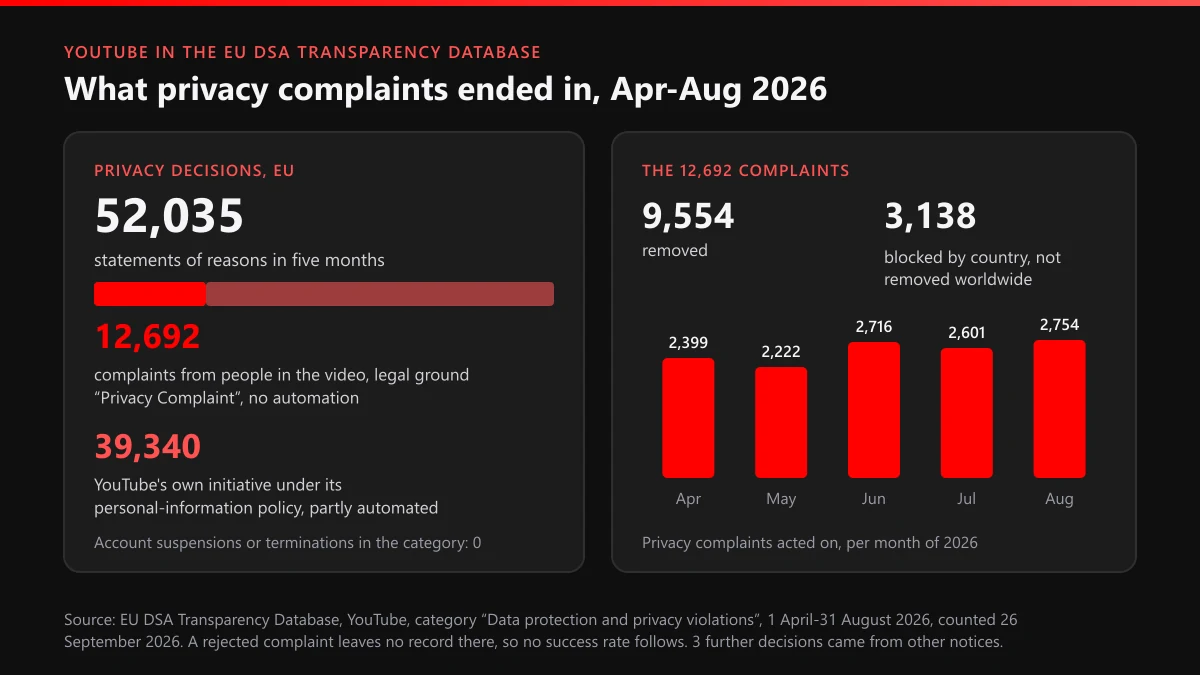
The same category holds a larger number that is easy to misread. Another 39,340 privacy decisions were YouTube acting on its own under its policy on personally identifiable information, the rule against posting someone's home address, phone number or passport number. All but six of those were logged as partly automated. Every one of the 12,692 complaint decisions was marked as taken without automation, so a person looked at each.
Now the limit. The database records only decisions that restricted something, and a rejected complaint leaves no entry. Nobody can divide one figure by another and publish a YouTube privacy complaint success rate, YouTube included; a service quoting you one made it up. What the count does show is steady throughput, from 2,222 decisions in May to 2,754 in August.
Volume plays no part. Each decision on a YouTube privacy violation report rests on one identifiable person in one piece of content, so twenty copies of the same complaint, or a mass-report bot pointed at the video, add nothing. Flags from the Report button run through a separate queue with its own figures, covered in what a flag on a YouTube video triggers.
Can a minor, or a parent, file a YouTube privacy complaint?
Yes, both. The form's "reporting for" menu, as YouTube Ban Service read it on 26 September 2026, has seven entries, and two of them are "Myself and I'm a minor" and "A minor." YouTube's privacy guidelines accept a complaint on someone else's behalf only from a parent or legal guardian, a legal representative, someone filing for a vulnerable person or a person without internet access, and close family of someone who has died.
A parent filing for a child enters the child's full legal name and explains the relationship in a box that takes up to 1,000 characters. Children get firmer protection in YouTube's own rules as well: the text it attaches to removals under its personal-information policy ends, "we take a stricter approach on content involving minors."
One question came up again on Reddit in August 2026: you agreed to a video as a child and want it gone as an adult. YouTube publishes no rule for consent given by a minor. File as "Myself and I'm an adult," give your age at the time and say who agreed on your behalf, then let the reviewer weigh it.
The menu also lists "A coworker or friend."
Don't take that as permission. The guidelines refuse complaints from "a husband, wife, cousin, brother, or sister," from coworkers and from companies, so a friend filing for you is the quickest way to a closed case. It is also why ban-service panels and sellers can't honestly file a privacy complaint about a stranger: the form wants your legal name, a signature and a statement that you are authorised to report.
Two cases belong elsewhere, and one belongs with the police. An AI fake of your face or voice goes through the form's third option, and the extra tests are set out in reporting deepfakes and defamation on YouTube. A channel built under your name is impersonation, and a copied @handle is a fight of its own; see claiming back a YouTube handle. Sexual images of anyone under 18 are never a privacy case: report them to NCMEC's CyberTipline in the US or the IWF in the UK, and use NCMEC's free Take It Down service, which lists YouTube among its participants.
How to file a privacy complaint on YouTube, field by field
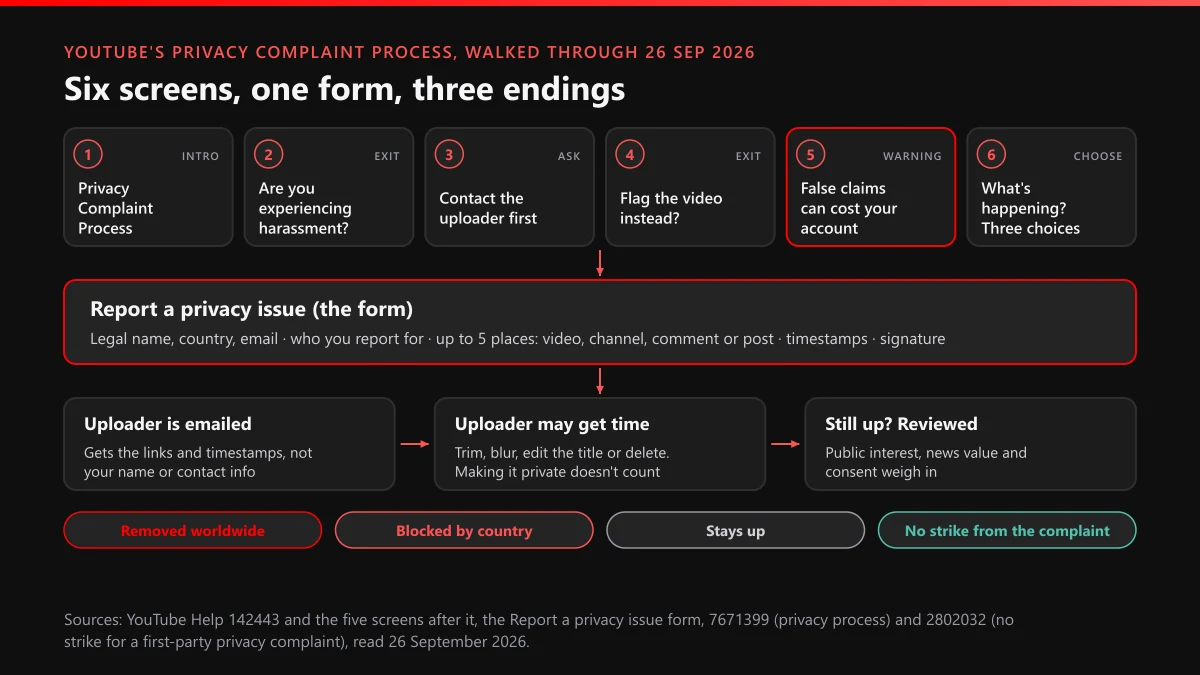
Set aside twenty minutes and use a computer, because the YouTube privacy complaint process is longer than any guide suggests. When we went through it on 26 September 2026, six help screens came before the form, each with an exit: screen 2 asks whether this is really harassment, screen 3 says "Please contact the uploader before you decide to file a complaint," screen 4 points you to the ordinary Report button, and screen 5 warns that false privacy reports can get your account suspended. Screen 6 asks "What's happening?" and ends with the YouTube Report privacy violation button.
- Gather everything first. Each link (video, Short, channel, comment or post), a timestamp for every moment you appear, and one line on what sets you apart in the frame: the red jacket, the seat by the window, your surname read out at 4:07.
- Open the form. Start at YouTube's Privacy Complaint Process page, click through the six screens and press Report privacy violation. The form that opens is headed Report a privacy issue.
- Pick the issue. Your image, voice or name; other personal info, where the form lists email, home address, business address, tax or ID number, phone number, credit card number and "Something else"; or AI changes to your image or voice.
- Say who you are and whom you report for. Full legal name, country and email address, then the seven-option menu.
- Answer the copy question. "Is this content a copy of material you posted on your own channel?" If yes, file a copyright notice as well.
- List up to five places. For each one choose Video, Channel, Comment or Post, paste the URL, tick where your info shows (the visuals, spoken audio, title, description or tags, the thumbnail, or a channel's name, description or avatar), add timestamps and describe what you look like or are doing.
- Tick the statements and sign. You confirm the report is true, that "sending a false report can cause my channel to be removed," and that you are authorised to report. A separate box covers a court order if you hold one. Type your name as the signature and submit.
Step 6 takes the longest, and its five-place limit is more useful than it looks. One complaint can carry the original video, the Short clipped from it and the channel whose avatar uses your photo, instead of three filings. A sixth place needs a second complaint. For a channel you give the channel link alone, since YouTube's guidelines say a whole-channel complaint needs no video URL; compare that with what a whole-channel report checks. For a comment, paste the comment's own link, and the guide to comment and reupload reports covers that side.
The YouTube privacy complaint form online sits at support.google.com/youtube/contact/privacy_complaint. It opened for us signed out, and YouTube says signing in pre-fills some details. Some guides call it the YouTube privacy violation form, after the button on screen 6.
On step 5: if the footage is yours, privacy is the weaker tool, and YouTube Ban Service asks who shot it before anything else. A copyright removal request can put a strike on the channel and a privacy complaint can't, and the takedown route for a stolen upload explains who counts as the owner.
What happens after you submit, and what does the uploader see?
The uploader hears first. The form says YouTube will "only share the YouTube links and video timestamps with them," while your name and contact details stay with the review team. YouTube may then give the uploader time to fix it: trim or blur in YouTube Studio, take your name out of the title, description or tags, or delete the video. A deleted video closes the complaint. Switching it to private doesn't count because, in YouTube's words, "you can change the status from private to public at any time."
How much time the uploader gets is the most repeated figure on this topic, and the shakiest. Most guides say 48 hours, and TechCrunch reported in July 2024 that YouTube would give the uploader "48 hours to act on the complaint." YouTube's current guidelines give no number, only "time." Treat 48 hours as history, and don't read a quiet first week as a refusal.
If the content is still up, a reviewer weighs public interest, newsworthiness, consent and whether the information is already public. Updates reach both sides by email.
What do the removal emails actually say?
When the answer is removal, YouTube files a copy of the uploader's email with the EU database, which is how YouTube Ban Service can quote it: "We have received a privacy complaint regarding your content. Upon our analysis of the claim, we have removed the content in question." It is signed by the YouTube Legal Support Team and ends with a line uploaders tend to miss: "You can submit the form only once per video url." One challenge per link.
A third ending gets almost no attention. Of the 12,692 EU complaint decisions, 3,138 blocked the video by country instead of deleting it. The records we opened blocked the video across the EEA and Switzerland and told the uploader, "We haven't applied a strike to your channel, and your content is still live on YouTube." A complainant in Germany can win while a viewer in Ohio still watches the clip.
On your side, YouTube sends updates, and any request for more information, to the email address you typed into the form. Uploaders who think a removal was wrong have that one-shot form in the email; appealing a YouTube removal or ban covers the wider picture, and terminated versus deleted channels explains what a channel stands to lose.
Does a privacy complaint put a strike on the channel?
No. YouTube's strike rules say that when content comes down because of "a first-party privacy complaint or a court order," the channel "won't get a strike," and the removal emails in the EU database repeat it. For anyone trying to stop a channel rather than one video, that single line changes the plan — the privacy form is built to clear the exposure, not to end the channel.
Privacy removals never count toward three strikes in 90 days. YouTube does say it will "suspend accounts that violate people's privacy," and it tells uploaders not to post another version featuring the same people, but it publishes no threshold. In the EU database, none of the 52,035 privacy decisions from April to August 2026 came with an account suspension or termination.
So when one channel keeps exposing you, the privacy form removes the exposure and a second route has to deal with the channel. YouTube Ban Service sorts cases this way before filing anything, and the table shows why.
| Route | Who files | Strike on the channel? | What it reaches |
|---|---|---|---|
| Privacy complaint | You, a parent or guardian, or a legal representative | No | Up to five videos, channels, comments or posts per complaint |
| Report button: harassment or doxxing | Anyone signed in, anonymously | Yes, once a reviewer confirms it | The content; three strikes in 90 days can end the channel |
| Impersonation form | You, or someone reporting another creator's channel | Yes, under the Community Guidelines | The fake channel |
| Copyright removal request | The owner of the footage, or their agent | Yes, a copyright strike | The copied upload |
| Court order | The person who obtained it | No | The content the order names |
The copyright row only helps if you own the footage, and the copyright strike rules spell out that count. For a channel built around targeting you, matching each violation to the route that removes it and a full channel takedown are the next reads. If the same person keeps posting your number under your own videos, hiding them from your channel stops it showing while the reports run.
What about YouTube's own privacy violations?
Those get settled in court, not through the form. In September 2019 Google and YouTube agreed to pay a record $170 million to the FTC and New York's attorney general over children's data collected without parental consent, and the order made YouTube build the system creators now use to mark videos as made for kids. A class action over the same conduct ended in a $30 million settlement that a federal judge in San Jose approved on 13 January 2026. Search results for YouTube privacy violations mix both meanings. Neither case takes down a single video of you.
Reddit's side of it: 190 threads, counted
Searches for "YouTube privacy complaint Reddit" want other people's outcomes, so on 26 September 2026 YouTube Ban Service pulled every post with "privacy complaint" or "privacy violation" in its title from r/youtube, r/PartneredYoutube, r/NewTubers and r/youtubers through the Arctic Shift archive. That gave 271 posts going back to October 2015. Merging reposts left 198 stories, and 190 of them were about the process itself.
The first surprise is who posts about YouTube privacy complaints. 91 came from uploaders who had received a complaint, against 69 from people who had filed one or wanted to; the other 30 are removed posts whose titles don't say. 84 of the 190 had lost their text, most of it removed by moderators, so for those we coded the title alone.
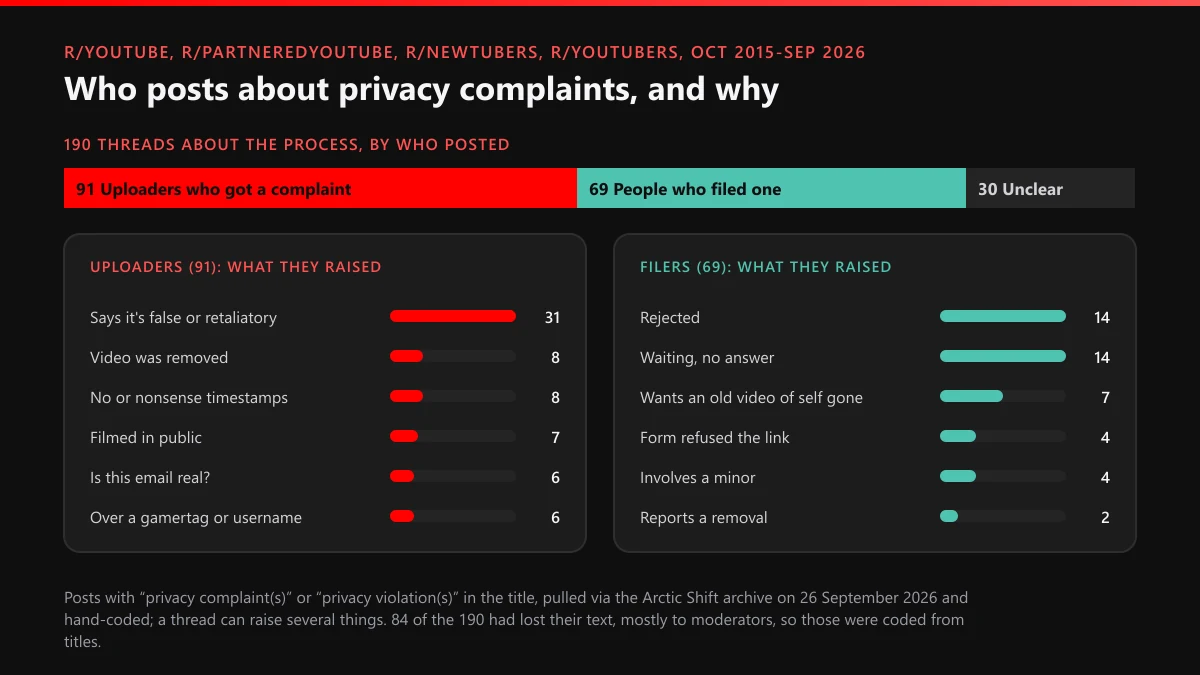
A third of the uploaders, 31 of 91, called their complaint false, bogus or retaliatory, and some describe waves: nine complaints with random timestamps on one video in July 2023, "hundreds" within a few hours on one channel in July 2024. In spring 2024 several notices arrived with phone numbers where the timestamps should have been, and six uploaders in 2024 and 2025 asked whether the email was even real. Six more complaints were about a gamertag or console username on screen. Serial false complaints are the privacy-form version of the trick sold as Instagram mass-report tools and spam-report bots. The form now makes the filer sign that a false report can cost them their own channel.
Filers tell a slower story. Of the 69, 14 said their complaint was rejected and 14 were waiting or had heard nothing. Only two said a video came down, and both were back because it had been uploaded again, once by the same channel and once by another. Seven wanted an old video of themselves gone, several of them from an account they could no longer open, and four between October 2024 and August 2026 said the form refused their link. The waits they describe run from three days to more than 30.
None of that is a success rate. People post when something goes wrong, and a removal rarely brings anyone back to say so. Read it as a map of where the process snags: identification for filers, notices without context for uploaders.
Why was my YouTube privacy complaint rejected, and what now?
Usually because the reviewer couldn't pick you out, not because they took the uploader's side. YouTube says "a first name without additional context, or a fleeting image, would not likely qualify," and that recognising yourself isn't enough: other people have to be able to. Find your case in the table before filing again.
| What the reviewer had | Why it fails | What to change |
|---|---|---|
| A face in a crowd for two seconds | Not uniquely identifiable | Every timestamp, what you wore, where you stood, plus a second identifier such as your name spoken or your street shown |
| A video you agreed to | Consent counts against you | Say what you agreed to and when; agreeing to be recorded is not agreeing to publication |
| A complaint sent by a friend, partner or sibling | Third-party claims are refused | File it yourself, or as parent, guardian or legal representative |
| A protest, crash, court case or public figure | Public interest and newsworthiness | Privacy rarely wins here; look at harassment or legal routes |
| The uploader blurred or trimmed you out | Closed as fixed | Check what's left: your voice, your name in the description, the thumbnail |
| The form refused the link | Unexplained in the posts that report it | Paste the full address from the browser bar instead of a share link |
A rejection ends that complaint, not your options. Filing again is fine when you add something new, such as timestamps you left out or an identifier you didn't name; sending the same text twice wastes the attempt. YouTube documents no appeal for the person who filed, but in the EU the Digital Services Act gives anyone who submitted a notice at least six months to contest the decision, free, through the platform's internal complaint system (Article 20), and after that a certified out-of-court body. The GDPR right to erasure in Article 17 is a separate data-protection request to Google, whose EEA controller is Google Ireland Limited, and it carries an exception for freedom of expression. In the UK, raise it with Google first; the ICO expects complaints within three months of your last meaningful contact.
Check the label, too. A video that lies about you rather than exposing you is a defamation or misinformation case, sorted in misinformation and counterfeit reports, and an ad using your photo to sell a scam goes through YouTube's ad and scam reports. Every other removal route is in how to get a YouTube video taken down.
Our advice, after reading the form line by line and counting the EU record: file it yourself, on a computer, with every timestamp and every identifier in the first complaint. The uploader gets one challenge per link, and outside the EU you get no documented second look. YouTube Ban Service prepares and files these through YouTube's own forms, while YouTube's privacy team makes the decision. To hand it over, send us the video link, see how our YouTube content removal service works, or browse the other YouTube reporting guides.
FAQ
Is there a YouTube privacy complaint email address?
No. You file on the Report a privacy issue form. YouTube then writes back to the email address you entered, including any request for more information. Uploaders get a separate notice, and the removal emails we read were signed by the YouTube Legal Support Team and asked for no password or payment.
How long does the YouTube privacy complaint process take?
YouTube publishes no timeline. The uploader may get time to fix the content first, a window guides still call 48 hours although YouTube's help no longer gives a figure, and a review follows only if the content is still up. People filing on Reddit describe waits from three days to more than 30.
Will the uploader know I filed the complaint?
YouTube won't tell them your name or contact details, because the form shares only the links and timestamps. You are still the person in the video, though, so an uploader who knows you can often guess; weigh that before filing against someone who has threatened you, and bring in the police where there is a threat.
Can I use the YouTube privacy violation form for someone else?
Only in narrow cases: as a parent or legal guardian, a legal representative, for a vulnerable person or someone without internet access, or as close family of a person who has died. Friends, partners, siblings, coworkers and companies can't, even though the form's menu lists "A coworker or friend."
Does the YouTube privacy complaint form cover AI videos of me?
Yes. Pick "Someone used AI to change my image or voice" and say whether the image or the voice was changed. YouTube weighs whether the clip is realistic, disclosed, identifiable, parody, or shows a public figure, and the form lets you add a link to a real video or photo of you for comparison.
Does making the video private settle a privacy complaint?
No. YouTube lists making a video private as an incomplete fix, because it can be switched back to public at any time. What counts is deleting the video, blurring the faces, trimming the part, or taking the name or details out of the title, description or tags.
Will YouTube ask for my passport or ID?
Not up front: the form asks for your legal name, country, email and a typed signature, plus a statement that you may need to send further documentation before YouTube can process the request. There is also an upload box for supporting documents if you have any.
Can I file a privacy complaint about a video filmed in public?
Yes; YouTube's privacy guidelines don't exclude public places. The reviewer weighs public interest and newsworthiness harder for protests, crashes or news events, though. A clear face together with your name or address in the caption stands a better chance than a passer-by shot.